Google & Microsoft AI Max: What Search Ads Lose Control
Search advertisers didn’t get a vote on this one. On September 1, 2026, Google started automatically migrating legacy Search campaigns, specifically the ones running Broad Match set at the campaign level and Automatically Created Assets, into AI Max. Microsoft Advertising moved almost the same week, rolling out its own AI Max globally and making it the default for every new Search campaign on the platform.
Most people are calling this “AI taking over paid search,” which is true enough but useless if you’re the one managing the account. The two rollouts aren’t identical, and neither is a headline. What actually matters is narrower: what changes in your interface, what disappears from your reporting, and how much runway you now have to catch something going wrong before it burns through the budget.
Google’s Migration vs. Microsoft’s Default: Two Different Moves
On Microsoft’s side, there’s no equivalent forced migration. Instead, AI Max just became the default configuration for new Search campaigns, which is a quieter but no less consequential move. AI Max for Search became generally available and is now switched on automatically for every new Search campaign created on the platform, but campaigns that predate the rollout aren’t being converted on their own.
That distinction matters in practice: if you’re not actively building new Search campaigns on Microsoft Ads right now, nothing changes for your existing accounts today, and there’s no clock running the way there is on the Google side. In practice, this means the real exposure isn’t your existing account, it’s whatever gets built next. A new campaign set up without a close look at the settings will launch on AI Max automatically, simply because that’s the starting point now rather than a choice you make.
| Google AI Max | Microsoft AI Max | |
| Scope | Existing campaigns (Broad Match, Auto-Created Assets) | New campaigns only |
| Opt-in required? | No, automatic migration | No, but only applies going forward |
| Existing campaigns affected? | Yes | No |
| Timeline | Began September 1, 2026 | Global rollout, ongoing |
This distinction matters for how you audit your accounts. If you manage Google Ads, you need to go check what’s already been moved. If you manage Microsoft Ads, you need to check what’s been created since the rollout, and confirm whether anyone on your team turned it off deliberately or just didn’t notice the setting.
What AI Max Actually Takes Control Of
“AI-powered campaign management” is vague enough to mean almost anything, so it’s worth being specific about what actually shifts from advertiser to platform.
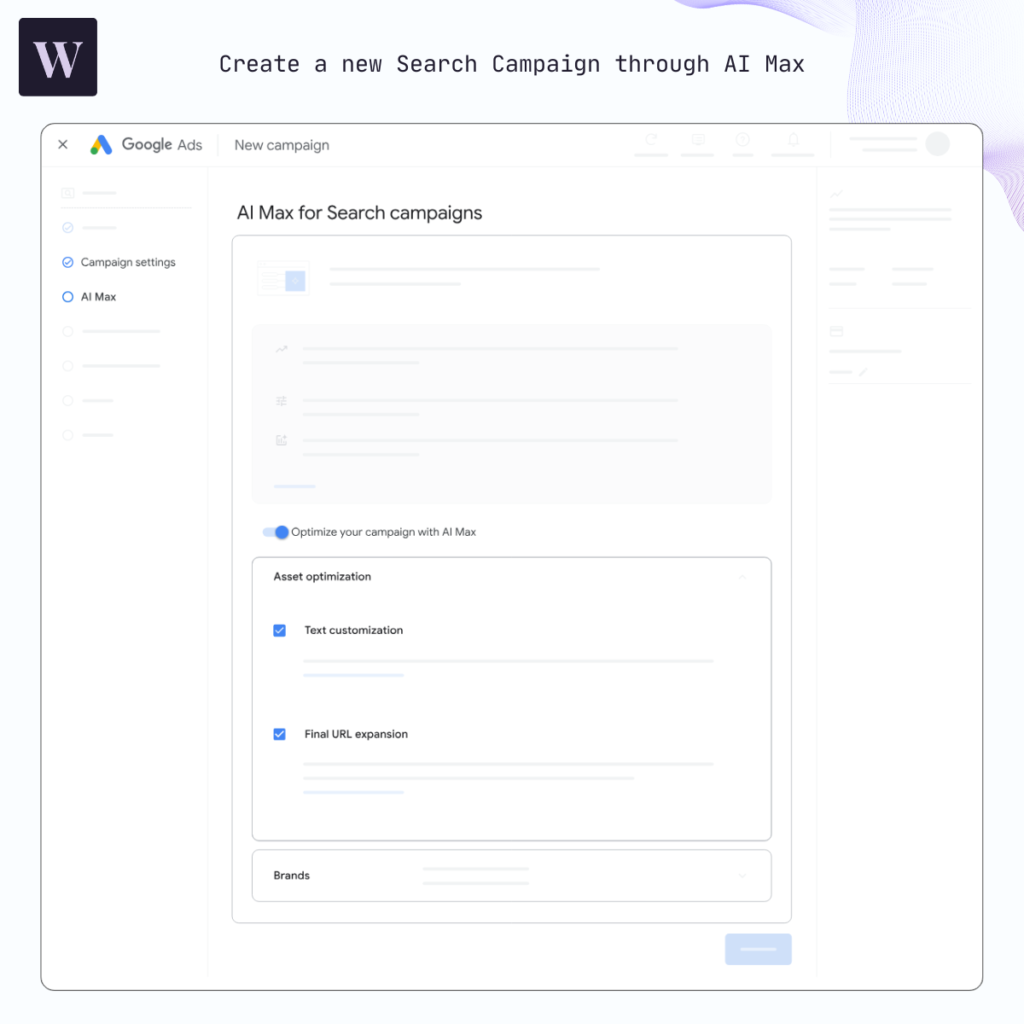
Notice that both Text customization and Final URL expansion are checked by default when you reach this screen. Nothing here requires you to opt in, you’d have to actively opt out of either one if you didn’t want AI Max touching your assets or your landing page routing.
Based on how Google and Microsoft have documented AI Max publicly, the areas most affected are search term matching, asset generation, and landing page selection. Under legacy Broad Match setups, you controlled match type behavior explicitly.
Under AI Max, the system expands matching using its own signals about query intent, which means the terms your ad shows for can move further from your literal keyword list than before. Automatically Created Assets already handle some headline and description generation, but AI Max extends that logic further into how those assets get tested and served, with less visibility into which combination is live at any given moment.
Landing page selection is the one that catches people off guard. That’s the Final URL expansion setting you just saw checked by default: if you’ve historically set a single landing page per ad group, AI Max in expanded form can route traffic to different pages across your site if it decides that improves relevance, which is a meaningfully different behavior from what most advertisers are used to reviewing and approving.
Here’s what to actually check, whichever platform you’re on. Find a campaign that’s now running AI Max, whether Google migrated it or Microsoft defaulted it in, and look at three things:
- First, whether your final URL settings still route to the pages you expect.
- Second, what your Search Terms report looks like compared to before the migration, specifically whether you’re now seeing query matches that fall further outside your original keyword intent.
- Third, whether asset reporting still breaks down performance by individual headline/description combination, or whether that visibility has been consolidated into a less granular view.
This is the audit that actually protects your account, and it’s the one most coverage of this news skips in favor of describing the change abstractly.
What Changes in Reporting After Migration
Once a campaign moves to AI Max, the reporting layer shifts in ways that aren’t always obvious from release notes alone.
The Search Terms report is the most immediately noticeable change. Advertisers reviewing this report post-migration are seeing broader query matches attributed to the same ad groups, which makes sense given the expanded matching behavior, but it also means your negative keyword strategy needs revisiting more frequently than it did under manual Broad Match. A negative list built for your old matching behavior won’t necessarily catch the new query expansion the same way.
Asset-level reporting is the second area worth watching closely. Where legacy Automatically Created Assets gave you visibility into which specific headline and description combinations were driving performance, the expanded AI Max asset system tends to report in more aggregated terms. If your reporting to clients or stakeholders has historically included asset-level performance breakdowns, confirm that data is still available at the same granularity, or be prepared to explain why it’s changed.
Conversion attribution is the third, and the most consequential. Because AI Max campaigns can route to different landing pages dynamically, attributing a conversion back to a specific creative-and-page combination gets harder. If your measurement setup relies on landing page-specific conversion tracking, this is worth stress-testing now rather than after a reporting gap shows up in a monthly review.
The Data Behind the Shift
Smartly’s 2026 Digital Advertising Trends Report has become one of the most-cited pieces of research behind this story, and it’s worth going to the source rather than relying on how it’s been summarized elsewhere. The report puts AI-driven creative scaling at 46% of marketers currently using AI to produce ad creative, with roughly a third of marketers running AI across creative, media buying, and measurement simultaneously, not just one part of the funnel. Separately, coverage of the same research found that 92% of marketers say AI is reshaping how they engage customers, a figure that’s been repeated less often than the creative-scaling statistic but arguably signals a broader shift than the narrower stat alone.
The uncomfortable number sitting alongside all of this is that a meaningful share of marketers still believe up to 30% of ad spend is wasted, despite the increased automation. That’s the tension worth sitting with: platforms are automating more of the decision-making, and marketers are handing over more control, while at the same time not reporting meaningfully improved confidence in where their budget is actually going. Automation and waste reduction aren’t the same thing, and the data so far doesn’t show one reliably producing the other.
Where Contextual Targeting Fits In
The AI Max story and the contextual targeting resurgence get covered separately most of the time, but they’re really the same underlying shift viewed from two angles. As platforms centralize control over audience targeting and matching decisions, the signals advertisers can still directly control shrink. Contextual targeting, placing ads based on the content and environment around them rather than individual user identity, is one of the few targeting levers that hasn’t been absorbed into platform-side automation in the same way.
Industry data on contextual advertising’s growth backs this up: as identity-based targeting continues to weaken under privacy restrictions, advertisers with limited first-party data are increasingly competing on message-to-context fit rather than audience-data depth. That’s a meaningfully different skill than the keyword and bid management most PPC practitioners built their careers on, and it’s worth treating as a distinct competency to develop rather than a minor tactical adjustment.
What to Check in Your Own Accounts This Week
Here’s what to check, pull up a campaign that’s now running AI Max, whether Google migrated it or Microsoft defaulted it in, and look at three things.
In Google Ads, go to your campaigns list and filter by campaign type or check the changes history for any campaign that used campaign-level Broad Match or Automatically Created Assets before September 1. If it’s been migrated, pull the Search Terms report for the 30 days before and after the change and compare query match breadth. Screenshot both for your records, especially if you report to clients, since “why did this change” is a question you’ll likely get asked.
In Microsoft Ads, check the campaign settings on anything created recently for whether AI Max is active, since it’s now the default and easy to miss if you’re not looking for it. If you didn’t intend to run AI Max, confirm the opt-out is available and documented for your team.
Across both platforms, revisit your negative keyword lists with the assumption that matching behavior has broadened, and check whether your landing page-specific conversion tracking still attributes correctly if traffic is being routed dynamically.
None of this is complicated, but it does require someone to actually go look, rather than assuming the platform handled it responsibly on your behalf.
Where This Is Heading
Both platforms have been pushing toward automated campaign management for years, and AI Max is just the most explicit step yet. Manual control over match types, asset selection, and landing pages is going to keep shrinking. Fighting it isn’t a strategy, what matters is catching what changed under the hood before it shows up in your numbers or in a client call.
For more on how automation is reshaping paid and organic strategy, browse our digital marketing coverage.