ZUS Coffee SEO Audit: Speed, Search & AI Visibility
ZUS Coffee has become one of Malaysia’s most recognisable coffee brands, built on an app-first model it describes on its own homepage as the “#1 Tech-Driven Coffee Chain”. Customers order through the ZUS app for pickup or delivery, and the brand has expanded quickly across the country.
With that kind of brand strength, we wanted to know: does ZUS’s website win search traffic beyond people already looking for it by name? This is the latest in our free site audit series, where we review well-known brands’ websites in public.
WebCrawlSpace examined zuscoffee.com across search visibility, AI visibility, site structure, on-page SEO and Core Web Vitals. All search data is from Ahrefs for Malaysia, as of 17 October 2026.
ZUS Homepage Overview: Desktop and Mobile
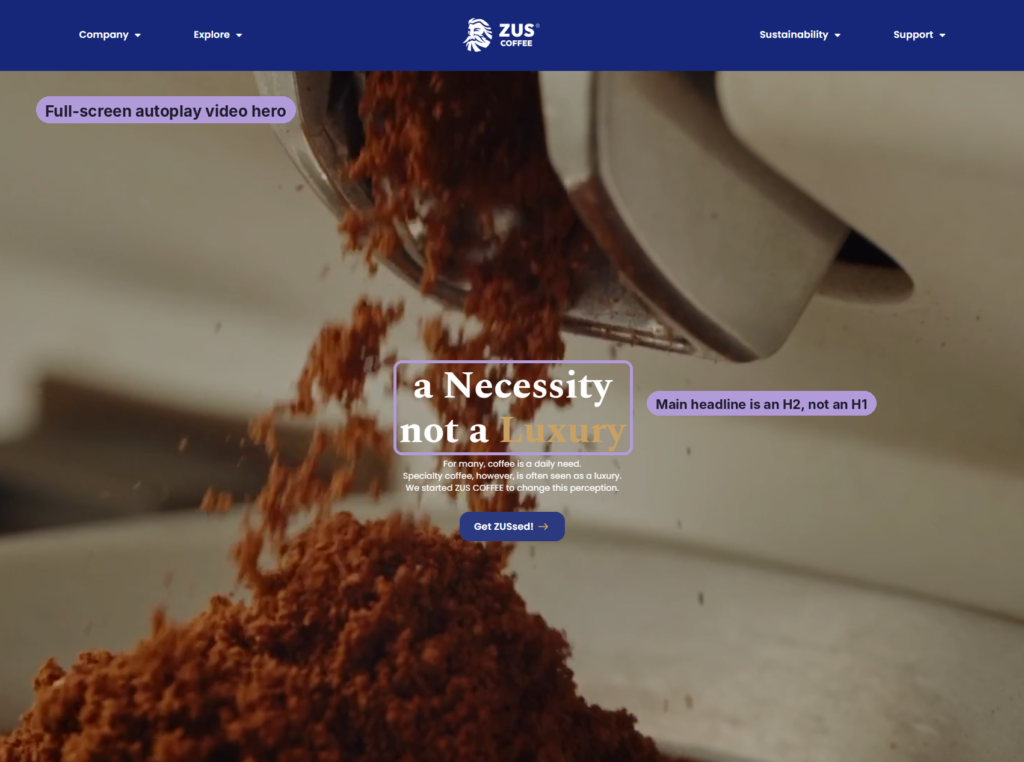
The homepage opens with a full-screen autoplay video behind the headline “a Necessity not a Luxury”. Below it, ZUS sets out its brand positioning (“Redefining Daily Necessity” and “Everyone Deserves Specialty Coffee”) and pushes visitors towards ordering through the app.
The design is bold and on-brand, but the page reads more like a brand showcase than a destination for searchers. Most of the copy is short slogans, so there’s little descriptive text explaining what ZUS offers.
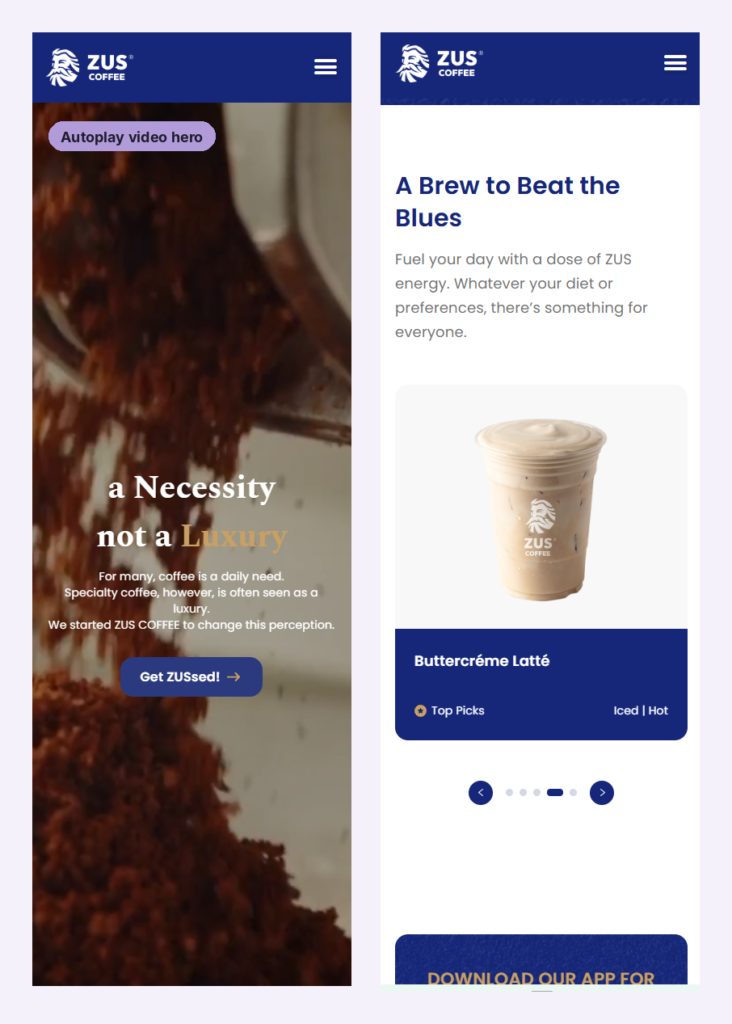
On mobile, the layout adapts cleanly: the video hero scales to fit the screen, and the drink carousel works well as a swipeable card.
On-Page SEO Check on ZUS’s Homepage
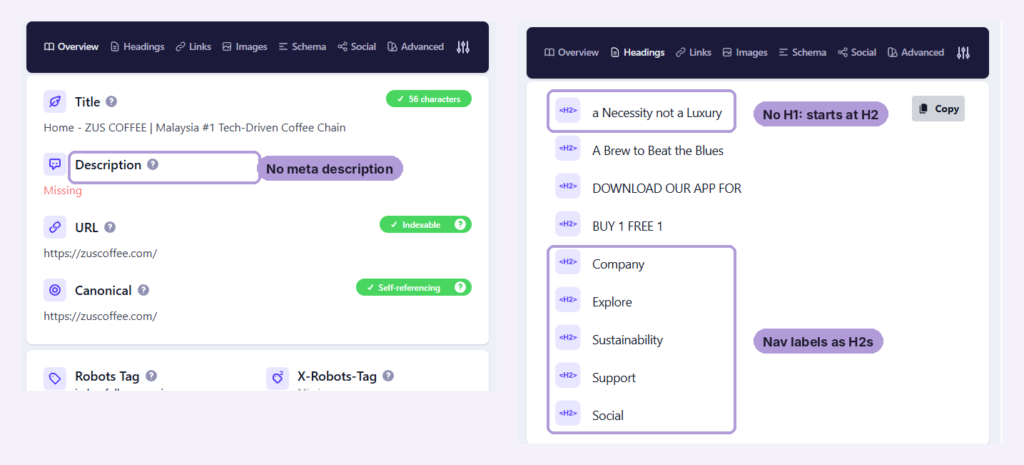
The homepage title, “Home – ZUS COFFEE | Malaysia #1 Tech-Driven Coffee Chain”, is 56 characters and fits in search results, though the “Home -” prefix wastes space. The page is indexable and self-canonical. But two basics are missing:
- No meta description: Google writes its own snippet, which often pulls random text from the page.
- No H1 tag: The page has no main heading at all. Even the navigation labels (Company, Explore, Sustainability, Support, Social) are marked up as H2s, while real section headings like “BUY 1 FREE 1” sit at the same level. That flattens the heading structure, giving search engines no clear signal of what the page is about.
Much of the homepage copy is short slogans rather than descriptive text. That gives search engines and AI systems little to work with when deciding what the page is about, beyond the brand name itself.
Search Visibility: A Brand-Powered Site
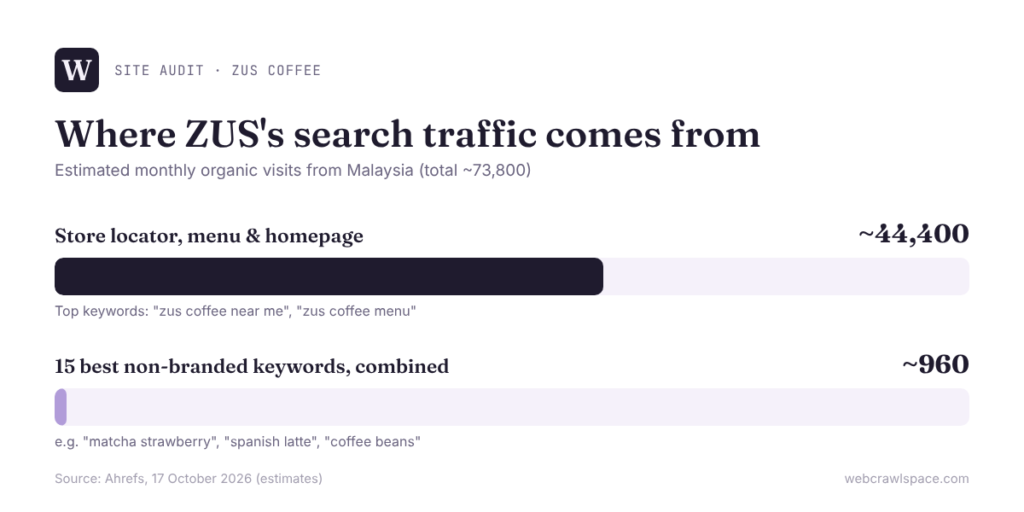
ZUS’s search traffic comes almost entirely from people already looking for ZUS. Ahrefs estimates about 73,800 monthly organic visits from Malaysia, with a Domain Rating of 52 and roughly 3,900 referring domains. That’s a strong foundation.
But the top three pages, the store locator, the menu and the homepage, bring in about 44,000 of those visits. Their top keywords are “zus coffee near me” and “zus coffee menu”.
Meanwhile, ZUS’s 15 strongest non-branded keywords combined bring in fewer than 1,000 visits a month, under 2% of the total.
| Non-branded keyword | Position | Monthly searches | Est. visits |
|---|---|---|---|
| matcha strawberry | 1 | 7,900 | 366 |
| spanish latte | 1 | 4,500 | 93 |
| mug | 1 | 4,100 | 52 |
| coffee beans | 8 | 1,800 | 22 |
| cham drink | 1 | 1,500 | 20 |
| kopi tarik | 1 | 800 | 31 |
Two things stand out:
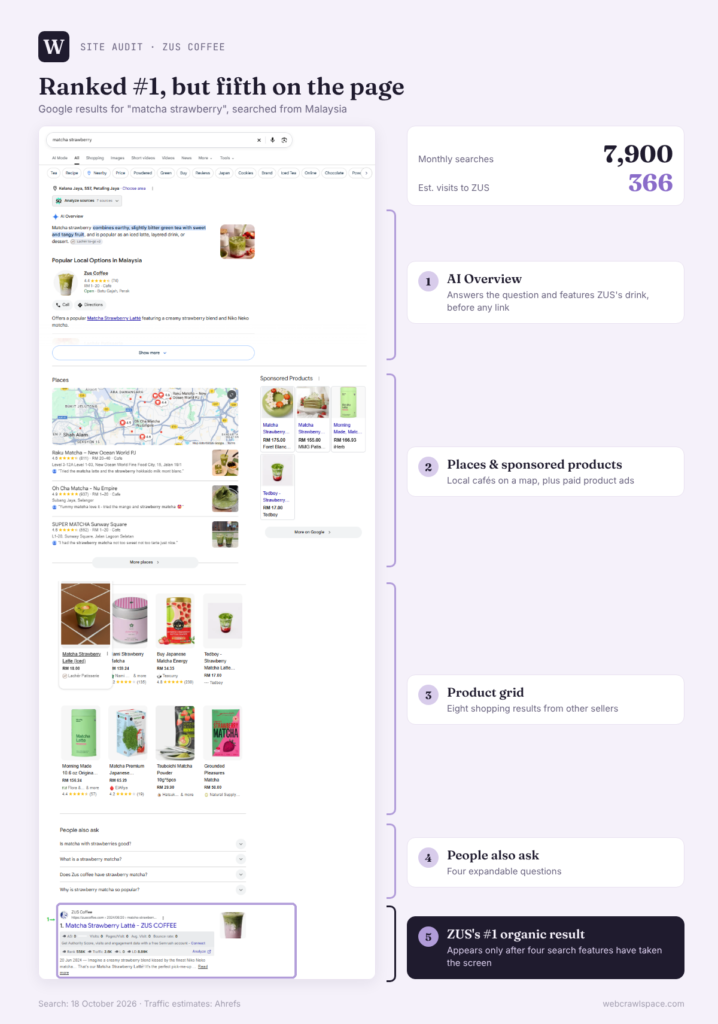
- Ranking first won’t necessarily convert into clicks: ZUS ranks #1 for “matcha strawberry”, with 7,900 monthly searches, yet gets an estimated 366 visits. Search features such as AI Overviews and image packs are likely absorbing most of the clicks above the organic result. We saw the same pattern in our OldTown White Coffee audit, where it ranked third for “white coffee” (2,600 monthly searches) but drew only about 70 visits.
- Page-one gaps exist: “Coffee beans” sits at position 8 with 1,800 monthly searches. That’s exactly the kind of commercial term a coffee brand with a shop should own.
AI Visibility: A Genuine Strength
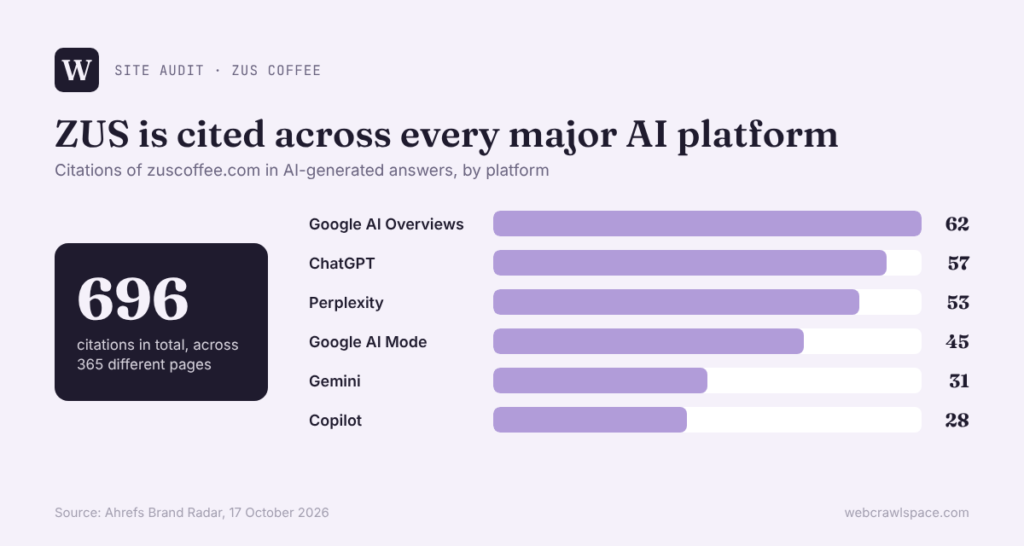
This is where ZUS stands apart from most Malaysian brands we’ve audited. Ahrefs tracks 696 citations of zuscoffee.com across AI platforms, covering 365 different pages
Google AI Overviews cites ZUS most often (62 citations), followed by ChatGPT (57) and Perplexity (53), with Google AI Mode close behind (45).
For comparison, fellow Malaysian coffee brand OldTown White Coffee appeared about 200 times across AI platforms, on just 17 pages, when we audited it. ZUS’s brand recognition, menu pages and store listings give AI systems far more concrete facts to reference.
The opportunity is in what those citations are for. Most likely relate to ZUS itself: its menu, prices and locations. Turning AI visibility into new customers means getting cited for broader questions too, like “best iced latte in KL” or “what is a Spanish latte”.
Site Structure: Drinks and Stores Published as Blog Posts
ZUS publishes its drinks and stores as dated blog posts rather than permanent pages. Its best non-branded page, for the:
- Matcha Strawberry Latte, sits at /2024/06/20/matcha-strawberry-latte/.
- Spanish Latte page is at /2022/05/27/spanish-latte/,
- And individual outlets like Pines Square Kuching live at /2024/06/24/zus-coffee-pines-square-kuching/.
This matters for three reasons:
- Dates signal age: A 2022 URL for a drink still on the menu tells users and search engines the page may be out of date.
- There’s no clear hierarchy: Drinks and stores sit alongside announcements like “launched first ZUS frappe” instead of under a /menu/ or /stores/ section.
- Store pages compete with each other: The Kuching outlet post ranks for “zus coffee near me”, the same keyword as the main store locator.
We also found a membership page available at two URLs (envipmember.zuscoffee.com/ and /_1), both ranking for “zus voucher” where Google may deem both pages to be a potential duplicate.
The Old Pages Are Still Live
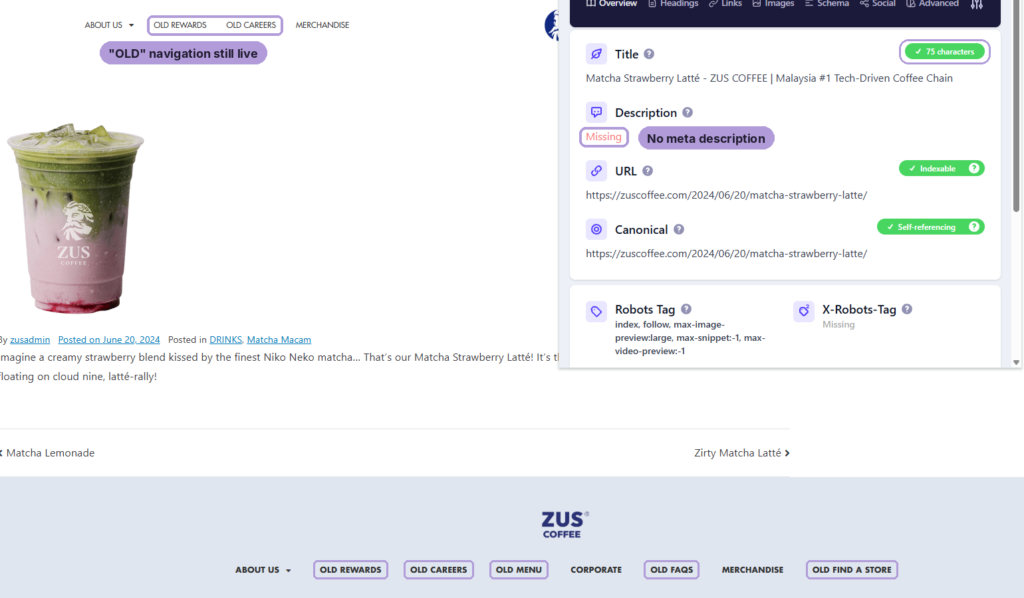
The drink pages aren’t just oddly structured. They belong to ZUS’s previous website. The Matcha Strawberry Latté page still carries the old navigation, with links labelled “OLD REWARDS”, “OLD CAREERS”, “OLD MENU”, “OLD FAQS” and “OLD FIND A STORE”.
The page is still set to index, so Google keeps ranking it. That means ZUS’s single best non-branded page, #1 for “matcha strawberry” with 7,900 monthly searches, is a legacy page with just two sentences of copy, no meta description, and a 75-character title that gets cut off in search results.
The current website has its own menu, but these old pages were never migrated or redirected. They still collect rankings the new site doesn’t capture.
Core Web Vitals and Page Speed
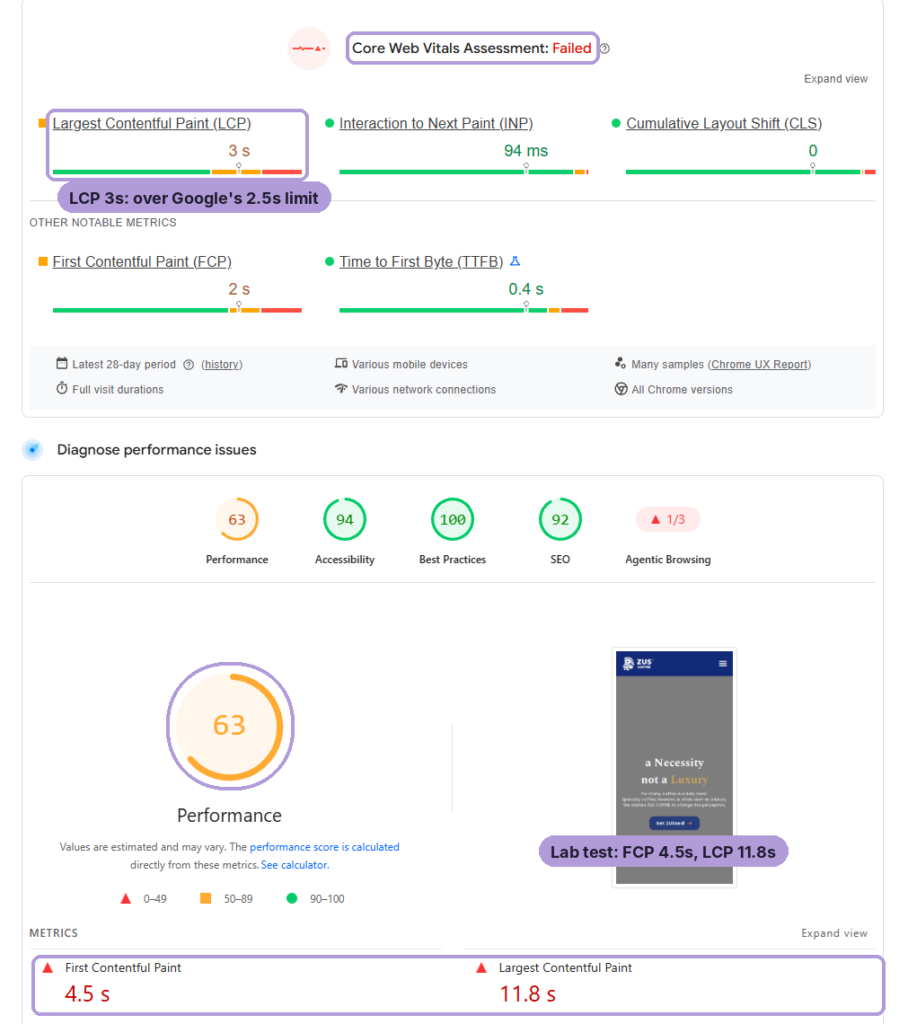
ZUS fails Google’s Core Web Vitals assessment on mobile. Real-user data from Chrome shows a Largest Contentful Paint of 3 seconds, just over the 2.5-second limit in Google’s Core Web Vitals thresholds. Interaction speed (INP, 94ms) and layout stability (CLS, 0) are both healthy, so the site responds well once it loads.
PageSpeed’s lab test, run on a throttled mobile connection, shows the problem more sharply. The Performance score is 63/100, with a First Contentful Paint of 4.5 seconds and an LCP of 11.8 seconds. The mobile filmstrip shows a blank white screen for the first few frames before the hero appears.
The main causes are clear:
- Render-blocking requests delay the first paint by an estimated 3 seconds.
- 391 KiB of unused JavaScript and 51 KiB of unused CSS load on every visit.
- The page weighs about 5.7 MB in total, heavy for a mobile homepage. The full-screen autoplay video at the top is a likely contributor, since it loads exactly where the Largest Contentful Paint is measured.
The rest of the technical picture is strong: Best Practices scores 100, Accessibility 94 and SEO 92.
Overall Site Score
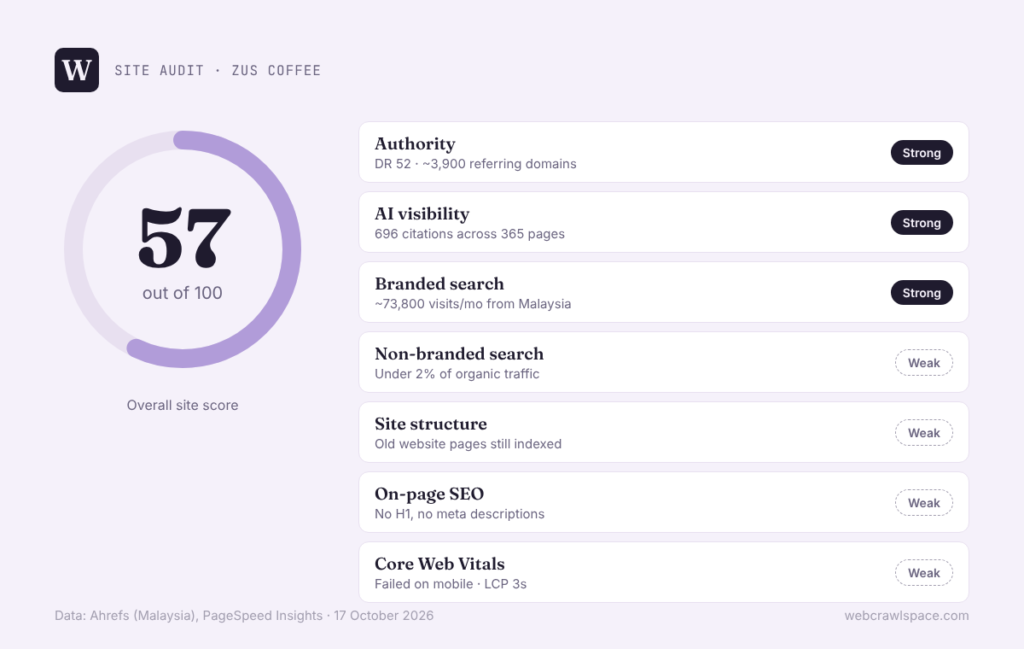
ZUS Coffee scores 57 out of 100. Its authority, AI visibility and branded search are among the strongest we’ve audited. The score is held back by a leftover old website, missing on-page basics and a slow mobile first load.
That puts ZUS well ahead of the other brands we’ve audited: OldTown White Coffee scored 40/100 and Zanroo scored 38/100. ZUS doesn’t need to build authority from scratch. It needs to clean up what it already has.
Where ZUS Goes From Here
ZUS has already done the hardest part: it built a brand people search for by name, and one AI systems cite. What the website hasn’t done yet is capture the much larger audience searching for coffee in general.
These are some fixes that ZUS Coffee Malaysia can begin from:
- Migrate or redirect the old website’s pages, then move drinks and stores into permanent sections, such as /menu/spanish-latte/ and /stores/pines-square-kuching/, with redirects from the old dated URLs.
- Turn drink pages into rich product pages with ingredients, price, calories and a link to order in the app.
- Target the coffee questions Malaysians ask, like “what is a Spanish latte” or “best coffee beans Malaysia”. With Google’s latest AI Mode update linking sources more prominently, clear answers like these are more likely to be cited.
- Add a homepage H1 and meta descriptions, and consolidate duplicate pages, starting with the two membership URLs.
- Speed up the mobile first load by deferring render-blocking scripts and removing unused JavaScript, which alone could cut about 3 seconds.
With its authority and AI presence, ZUS is better placed than most Malaysian brands to win non-branded search. It just needs the site structure to match the strength of the brand.
A Note From WebCrawlSpace
If any of the issues raised here look familiar on your own website, the good news is that most of them are fixable with the right prioritisation and execution. For a faster, more direct path to results, reach out to WebCrawlSpace at [email protected] and we will help you turn these findings into action.
One Comment