Google is Quietly Rebuilding Ads Inside AI Mode
Key takeaways
- Google has tested at least four distinct AI Mode ad changes since mid August 2026: a disclosure line, ad descriptions, text link ad formats, and inline shopping carousels.
- None of these changes were formally announced by Google. All were spotted and reported independently.
- The push is tied to revenue. Alphabet linked Search revenue growth to AI driven query volume, and AI Mode ads now reportedly appear on close to 30% of queries.
- Advertisers don’t need a separate AI Mode strategy yet, but asset and description quality inside existing campaigns matters more than before.
Something has been shifting inside Google AI Mode for weeks, one small test at a time. Ads there now carry descriptions, a disclosure line separating sponsored content from Google’s own commentary, and even text link formats designed to blend in with the surrounding answer. None of it has been formally announced. It’s shown up through spotted screenshots and independent reporting instead, but the direction is unmistakable. Google is actively building out how ads live inside AI generated answers, not just testing whether they belong there at all.
What’s Changing
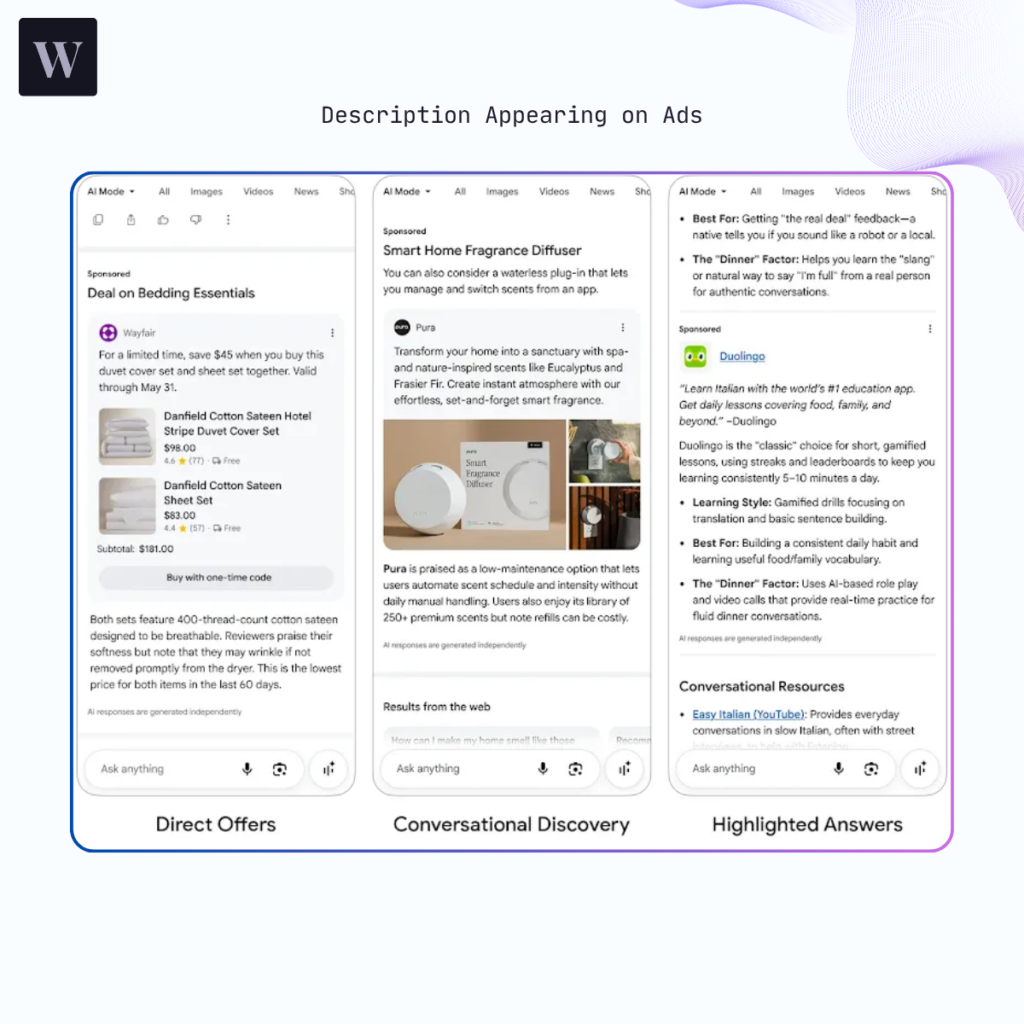
Line up the last few weeks of sightings and a pattern emerges. This isn’t one test, it’s a sequence:
- Ad descriptions added: On September 16, ads appearing at the bottom of AI Mode started showing ad descriptions alongside them, something previously reserved for sitelinks only. It’s a small addition, but it gives the advertiser more room to say something before a user decides to click.
- A disclosure line added earlier: A few weeks before that, Google began appending a line to these ads noting that the surrounding AI commentary is generated separately from the ad itself. It’s a clear attempt to separate what Google’s AI “says” from what an advertiser paid to say.
- Text link ads that look like answers: Around the same period, Google tested a format where sponsored links appear as ordinary looking text inside the AI Mode response itself, tagged as an ad above the block rather than set apart in a distinct unit.
- Shopping ads woven into results: Independent researcher Brodie Clark spotted a shopping carousel embedded directly inside an AI Mode answer, with a second batch of sponsored products sitting further down the same page. Google hasn’t acknowledged the placement in any official capacity.
Taken individually, each of these reads as a minor UI experiment. Taken together, they describe Google building a full ad toolkit for a surface that, by design, is meant to answer a question rather than list links.
Why Google Can’t Afford to Wait
The pressure behind this is financial, not experimental. Alphabet’s Q2 2026 results attributed a significant share of Search revenue growth directly to AI driven query volume. That means more of Google’s searches are already happening inside AI Mode and AI Overviews, surfaces that historically carried little or no ad inventory. A separate SE Ranking study found AI Mode ads now reach nearly 30% of queries, up sharply from where the feature started.
Put plainly, as more search volume shifts into conversational, AI generated answers, Google has to build ad inventory into those answers or watch a growing share of its search revenue quietly evaporate. That’s the real story behind every one of these small format tests. They’re not cosmetic, they’re revenue infrastructure.
What Advertisers Should Do
- Treat ad copy as answer copy: With descriptions now showing next to AI Mode ads, weak or generic ad text is more visible than before. Write descriptions that could stand on their own as a helpful answer, not just a pitch.
- Don’t build separate AI Mode campaigns yet: None of these formats currently require a distinct campaign type. They’re surfacing through existing Search and Shopping campaigns instead. Chasing a standalone AI Mode strategy right now is premature. The priority is asset quality inside the campaigns already running.
- Audit asset coverage: Formats like these tend to favor advertisers with multiple distinct headlines, descriptions, and structured product data. Thin or templated assets are the ones most likely to be excluded or shown poorly.
- Watch impression shares and CPCs, not just clicks: As inventory shifts into AI Mode, some of the movement in account performance over the next few months may trace back to these format changes rather than anything an advertiser did.
- Expect more tests, not a finished product: Every format covered here shipped without an announcement. Advertisers who wait for an official Google blog post before reacting will consistently be a step behind.