ChatGPT Ads Are Spreading Fast: What the Latest 2026 Data Reveals
When OpenAI first placed sponsored listings inside ChatGPT earlier this year, many marketers treated it as a small experiment that would take years to matter for their budgets. Seven months later, independent measurement from Comscore, SE Ranking and OtterlyAI tells a very different story, showing that ads have quickly become a regular part of commercial conversations on the platform. This article brings together the most important findings so you can understand how often ChatGPT ads appear, which industries see them most, and what the shift means for your AI search strategy and paid media planning.
How ChatGPT Ads Work
OpenAI began testing ads in the United States on February 9, 2026, and describes its approach as a gradual, phased expansion guided by real world feedback. The sponsored units are placed underneath the end of a response, carry a clear sponsored label, and are visually separated from the answer itself, while OpenAI maintains that advertisers have no way to shape or rank what ChatGPT says. Only people on the Free and Go tiers see these placements, since subscribers on Plus, Pro, Business, Enterprise and Education plans remain ad free.
That structure matters for anyone trying to interpret the data, because every study below is measuring ads shown to a subset of users rather than the entire ChatGPT audience.
Comscore Data Shows Gaming Conversations Jumped From 3% to 47%
The most striking numbers come from Comscore’s newest research. According to its Q2 2026 AI Intelligence Report, published on September 22, sponsored ads showed up in 47% of the video game and console conversations it tracked in June, compared with only 3% back in March. Gaming stayed at 3% to 4% through April before climbing to 18% in May, which means most of the growth happened within a single month.
Other retail categories followed the same upward direction, although more gradually. Toys and hobbies rose every month from 5% in March to 24% in June, while books, music and video moved less predictably, going from 9% to 12%, dipping to 8% in May, and then climbing to 22% in June.
The timing is worth noting for anyone tracking the platform’s development. June was the first complete month after OpenAI started rolling out its beta self serve Ads Manager, although Comscore does not claim a direct connection between the two events.
Readers should also keep the limitations in mind before drawing firm conclusions. The figures reflect only desktop activity in the United States from an opt-in panel, and the report does not disclose how many conversations sit behind each monthly percentage or whether a single ad anywhere in a chat is enough to count. Comscore also published earlier travel data showing a similar pattern, as sponsored ads appeared in 6% of hotel related prompts with source links in March, rising to 24% by May.
SE Ranking Found Ads on One in Four Commercial Prompts
SE Ranking took a different approach by writing and running a large set of commercial prompts on a single day. The team analysed 50,006 commercial prompts spread across 20 niches in the United States, collected on July 23, 2026, and found that 25.94% of them triggered an ad.
The more surprising finding concerned ad relevance rather than frequency. Roughly one ad in every seven had no real topical link to the prompt it appeared in, and in niches such as Relationships and News and Politics the mismatch rate climbed above 50%. This suggests OpenAI’s targeting system is still maturing and that advertisers should watch where their budgets are actually being spent.
The study also revealed a clear gap between paid and organic visibility. Advertisers were cited as a source within ChatGPT’s own answer in only 3.63% of ad placements, compared with 11.53% in Google AI Mode. In other words, buying an ad on ChatGPT rarely coincides with earning a mention in the answer itself.
On the advertiser side, SE Ranking identified 1,159 unique advertisers, and a single fintech platform called BestMoney was responsible for 13.56% of every ChatGPT ad unit recorded.
OtterlyAI Reports Ads in Three Out of Four Shopping Answers
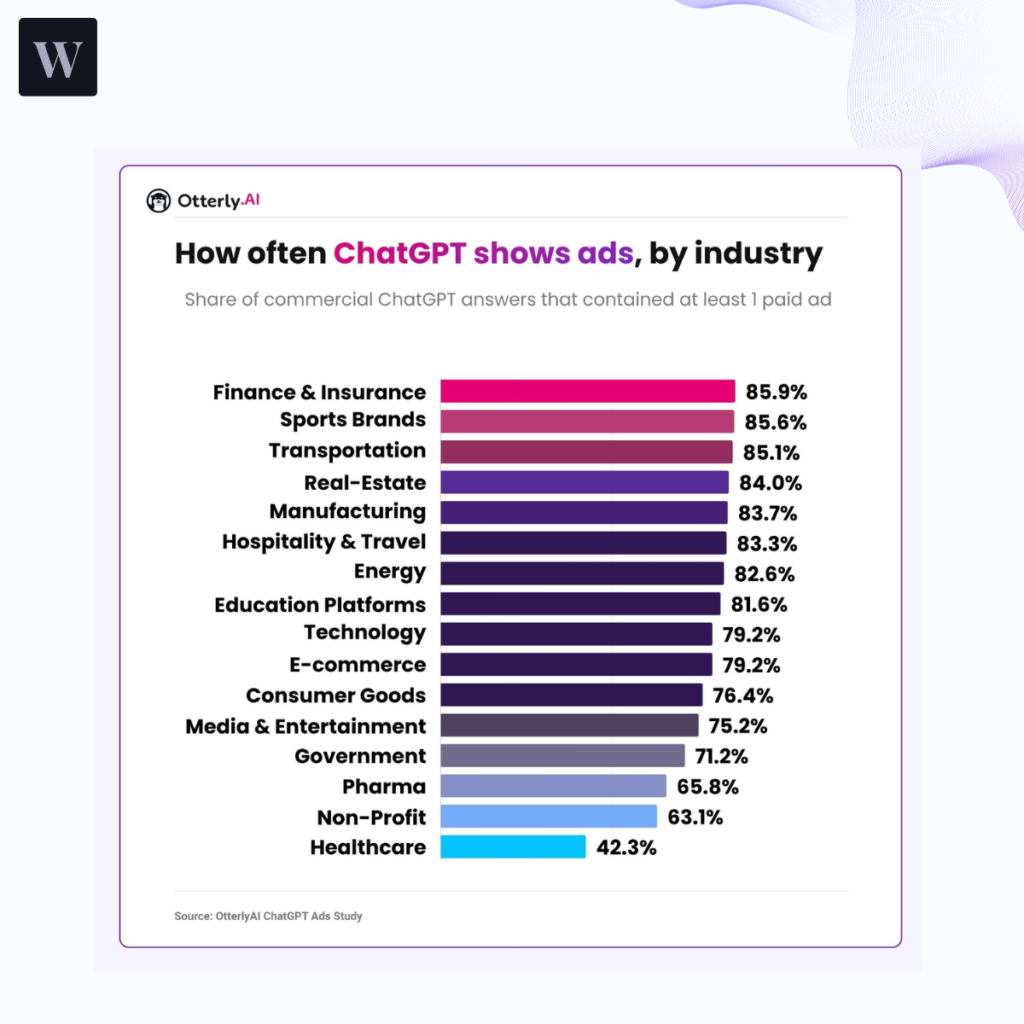
OtterlyAI focused exclusively on questions with buying intent, which explains why its figures are much higher than the other studies. Using first party data gathered over two weeks in July 2026 in the United States, the company found that 76.4% of answers to shopping questions contained at least one ad.
The industry breakdown shows how uneven ad pressure is across sectors. Finance and Insurance was the most saturated category with ads in 85.9% of answers, while Healthcare was the least saturated at 42.3%.
Perhaps the most strategically interesting result is who is not advertising. In 12 of the 14 industries studied, the category leader, including brands such as Zillow, Uber and Nike, ran no ChatGPT ads at all, which leaves the inventory open for challenger brands. Product shopping cards were also rare, showing up in only 2.2% of answers and in just half of the industries covered.
Why the Numbers Differ So Much Between Studies
At first glance, figures ranging from roughly 25% to 76% can look contradictory, but each study is measuring something quite different. Comscore observes real user conversations from a panel over several months, which captures natural behaviour but mixes in conversations where no ad would ever be expected. SE Ranking tested vendor written commercial prompts on one day, which gives a large, controlled sample but only a single snapshot in time. OtterlyAI limited its dataset to shopping questions, which are exactly the prompts most likely to trigger an ad, so its higher percentage is a natural result of that narrower focus.
Taken together, the three studies point in the same direction even though their exact numbers disagree, because all of them show that ads are now common wherever a conversation carries commercial intent.
How Quickly OpenAI Has Expanded Its Ads Business
The data makes more sense when placed alongside OpenAI’s own announcements, which show a product moving from pilot to global platform in a matter of months.
In May, OpenAI started rolling out a beta self serve Ads Manager, added cost per click bidding alongside expanded measurement tools, and brought in agency partners such as Dentsu, Omnicom, Publicis and WPP along with technology partners including Adobe, Criteo, Pacvue and StackAdapt.
International expansion followed during the summer. By August 11, ChatGPT Ads had launched in the United Kingdom, Mexico, Brazil, Japan and South Korea, and self service access through Ads Manager became available across 31 European markets on August 31.
The commercial results have been significant for a product this young. OpenAI says ChatGPT Ads passed a $1 billion annualised revenue run rate in fewer than 200 days, is now used by tens of thousands of advertisers, and has opened self service buying across India, Europe, the Middle East and North Africa.
The newest features point toward deeper integration with the tools marketers already use. OpenAI is testing Sponsored Agents, which allow people who click an ad to start a separate conversation with an agent sponsored by the business, and it has launched integrations with HubSpot as its first CRM partner and Shopify as its first ecommerce partner.
Which Industries Face Advertising Restrictions
Not every business can advertise freely on the platform. According to one agency guide, sensitive categories such as health, financial and legal services, alcohol and tobacco, gambling, dating and political advertising are either restricted or reviewed manually on a case by case basis instead of being approved automatically. Because this comes from a third party source, businesses in regulated industries should confirm the current rules directly with OpenAI’s advertising policies before planning any campaign.
What This Means for SEO and Paid Search Teams
For organic search teams, the key lesson is that paid placements and answer citations are separate systems. Since advertisers are rarely cited within the answers where their ads appear, earning a mention inside ChatGPT’s response still depends on strong content, clear entity signals and trustworthy sources, which makes AI visibility optimisation just as important as it was before ads arrived.
For paid search teams, ChatGPT is quickly becoming a genuine channel worth testing, particularly in categories where market leaders have not yet started advertising. OpenAI’s own figures indicate that around one in five ChatGPT conversations carries shopping intent across areas such as retail, beauty, travel, electronics and fitness, which gives brands a sizable pool of high intent users to reach. Early vendor benchmarks place a good ChatGPT conversion rate at between 4% and 7% for most commercial verticals, although these figures come from a tool provider and should be treated as a starting reference rather than a guarantee.
Advertisers who do test the platform should monitor placement relevance closely, since the SE Ranking data suggests a meaningful share of ads still appear beside unrelated conversations. Businesses in restricted industries, on the other hand, may find that investing in organic AI citations delivers more reliable visibility than waiting for paid access to open up.
Final Thoughts
ChatGPT advertising has grown from a limited United States test into a global platform with a billion dollar run rate in well under a year, and independent data now confirms that ads are appearing in a large and growing share of commercial conversations. The exact percentages will keep changing as OpenAI expands markets, adds formats like Sponsored Agents, and refines its targeting, so marketers should follow new studies closely and treat every figure within the context of how it was measured.
The brands that benefit most will likely be the ones that combine smart paid testing with a consistent effort to earn organic citations inside the answers themselves, and if you want to see how your own brand currently appears in AI generated answers, our free AI visibility audit series is a practical place to start.