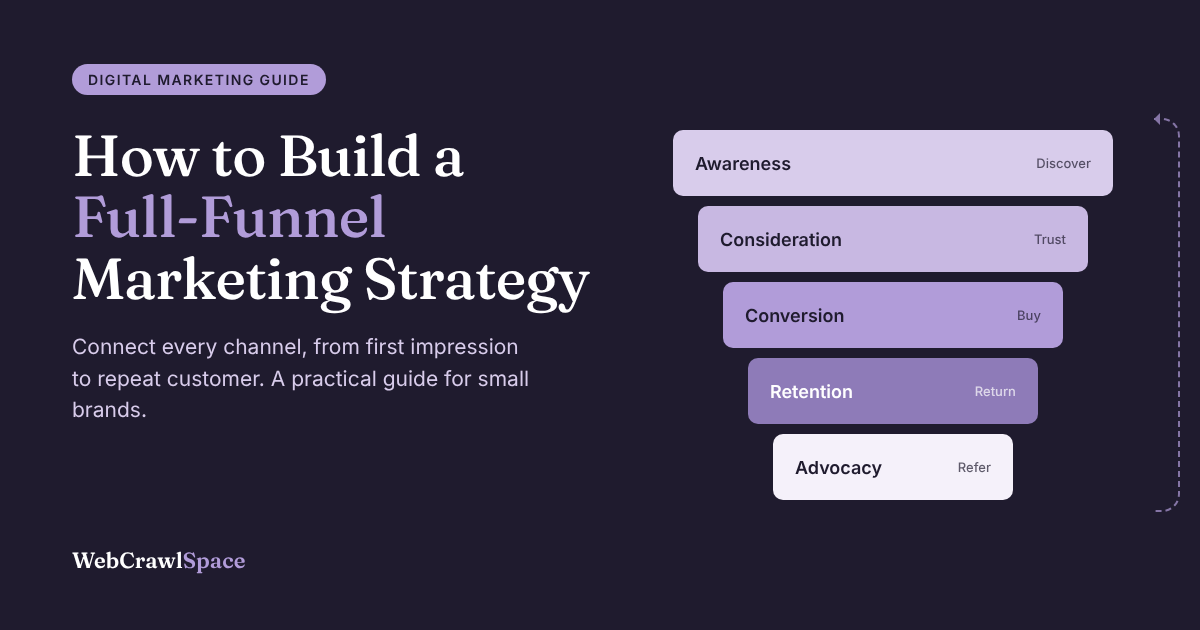
How to Build a Full-Funnel Marketing Strategy: A Practical Guide for Small Brands
Stop running ads, social and SEO as separate jobs. Here’s how to connect every channel into one funnel that moves people from first impression to repeat customer.
Most small brands don’t have a marketing problem. They have a handoff problem. The ads bring in clicks, the Instagram page gets likes, the website gets the occasional visit from Google, but none of it connects. Someone discovers you on TikTok, forgets your name by Thursday, and buys from a competitor who reminded them at the right moment.
A full-funnel strategy fixes the handoffs. Instead of asking “which channel should we run?”, you ask “what does someone need at each step before they’re ready to buy, and how do we move them to the next one?” This guide walks through that framework stage by stage, with channel picks, KPIs, budget starting points and three worked examples for Malaysian businesses. By the end you’ll have a one-page funnel map you can actually use.
What a Full-Funnel Strategy Actually is
A marketing funnel describes how ready someone is to buy. At the top are people who’ve never heard of you. At the bottom are people with their card out. A full-funnel strategy means you deliberately plan marketing for every stage in between. Just as importantly, you plan how people move from one stage to the next.
The key shift is thinking in stages of buyer readiness, not in channels. Instagram isn’t a stage. Google Ads isn’t a stage. A single channel can serve several stages depending on what you put on it: a Meta ad can introduce your brand to strangers, or it can retarget someone who abandoned their cart yesterday. Those are two completely different jobs.
Why Bottom-Only Marketing Gets Expensive
Many small businesses spend almost everything on conversion: search ads for “buy X near me”, promo posts, discount codes. It works at first because you’re harvesting demand that already exists. The problem is that the pool is finite and every competitor is fishing in it. Costs per lead creep up, and when you pause spend, sales stop dead because nothing upstream is creating new demand.
A full-funnel approach spreads effort so that the top of the funnel keeps refilling the bottom. The retention stage then gets more value from customers you’ve already paid to acquire. It’s slower to set up and steadier to run.
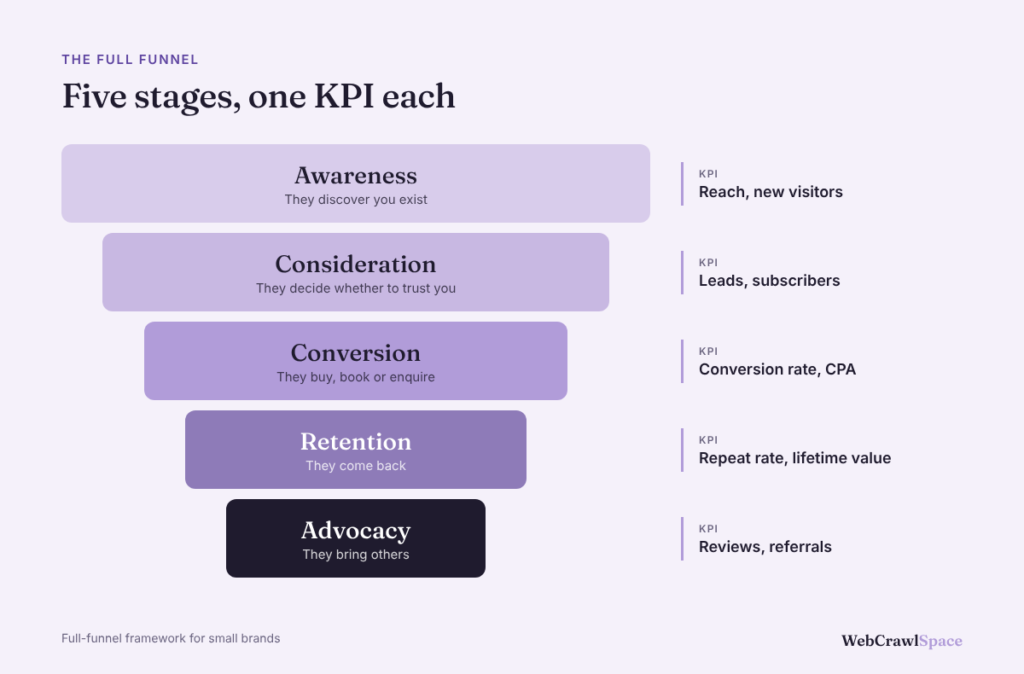
The Five Stages and What Each One Needs To Do
For each stage below, you’ll see the buyer’s mindset, the job your marketing has to do, the channels that usually fit, and the one metric that tells you whether that stage is working.
1. Awareness: Reach and First Impressions
- Buyer mindset: “I have a problem or a want, but I don’t know you.”
- Your job: Get in front of the right people and be memorable enough that they recognise you next time.
- Channels: Short-form video (TikTok, Reels), SEO content answering broad questions, PR and local media, influencer and creator collaborations, broad-audience social ads.
- KPI to watch: Reach and new-visitor growth. For paid, cost per thousand impressions.
The common mistake here is judging awareness content on sales. A video that reaches 40,000 people in your city and sells nothing directly may still be the reason your retargeting ads work next week. AI chat platforms are becoming a paid channel too. Measure this stage on whether it brings fresh people into the funnel.
2. Consideration: Earning Trust
- Buyer mindset: “I know you exist. Are you any good, and are you right for me?”
- Your job: Answer objections, show proof and capture a way to stay in touch.
- Channels: Comparison and how-to content, case studies, reviews, retargeting ads, lead magnets, email sign-ups, WhatsApp opt-ins.
- KPI to watch: Leads or subscribers captured, plus engaged visits (time on page, return visits).
This is the stage most small brands skip entirely, and it’s where most potential customers quietly drop out. If someone visits once and you have no way to reach them again, you’ve paid for a click and lost the person.
3. Conversion: Removing Friction
- Buyer mindset: “I’m ready. Make this easy.”
- Your job: Give a clear offer and the shortest possible path to buying, booking or enquiring.
- Channels: Focused landing pages, high-intent search ads, click-to-WhatsApp, live chat, a simple checkout, cart-abandonment reminders.
- KPI to watch: Conversion rate and cost per acquisition.
At this stage, fixing friction usually beats buying more traffic. A form with eight fields, a WhatsApp link that opens a blank chat, or a checkout that forces account creation will undo everything the earlier stages built.
4. Retention: Getting the Second Purchase
- Buyer mindset: “That was fine. Will I think of you next time?”
- Your job: Make the first experience good, then stay present until they need you again.
- Channels: Post-purchase email and WhatsApp flows, loyalty programmes, replenishment reminders, member-only offers, customer-only content.
- KPI to watch: Repeat purchase rate and customer lifetime value.
Retention is usually the cheapest revenue you’ll ever earn, because you’ve already paid to acquire the customer. Even a simple “thanks, here’s how to get the most from your order” message, followed by a reminder at the right interval, can lift repeat sales noticeably.
5. Advocacy: Turning Customers Into a Channel
- Buyer mindset: “I like this. I’d tell a friend if it were easy.”
- Your job: Make recommending you effortless and worth their while.
- Channels: Review requests (Google Business Profile, marketplace reviews), referral offers, user-generated content campaigns, community groups.
- KPI to watch: New reviews per month and referred customers.
Advocacy closes the loop. A new Google review or a customer’s Instagram story feeds straight back into the awareness and consideration stages for the next buyer.
How to Build Your Funnel
You don’t need a big team to do this. You need one honest afternoon and the willingness to drop channels that don’t earn their place.
Step 1: Define One Core Customer and Their Buying Trigger
Pick the single customer type that brings in the most revenue today. Then write down what makes them start looking: a new house, a birthday, running out of a product, a bad experience with a competitor. The trigger tells you when and where to show up at the top of the funnel.
Step 2: Map What you Already Do to Each Stage
List every marketing activity you currently run and assign it to a stage. Most brands discover the same thing: lots of conversion activity, a bit of awareness, and almost nothing for consideration or retention. The empty stages are your biggest opportunities.
Step 3: Pick One or Two Channels Per Stage
Resist the urge to be everywhere. A small team doing two channels well at each stage will outperform one doing six badly. Choose based on where your core customer already spends time and what you can realistically produce every week.
Step 4: Build the Bridge Between Stages
This is the step that turns a channel list into a funnel. For every stage, decide what specifically moves someone to the next one. For example:
- Awareness → Consideration: retarget video viewers with a review-led ad, or link a blog post to a free guide.
- Consideration → Conversion: send new subscribers a time-limited first-order offer.
- Conversion → Retention: send a post-purchase message with usage tips, and schedule a reminder for the reorder date.
- Retention → Advocacy: send a review request after the second purchase, when satisfaction is proven.
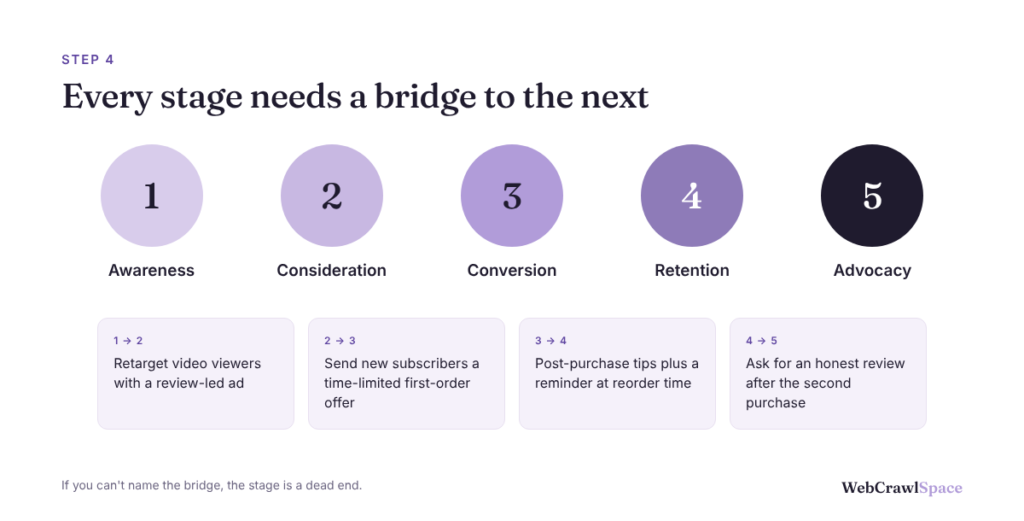
If you can’t name the bridge, the stage is a dead end.
Step 5: Set One KPI Per Stage, Plus a North-Star Metric
Use the stage KPIs above so each part of the funnel is judged on its own job. Then pick one north-star metric for the whole system. For most small brands, that’s monthly revenue from new and returning customers combined. For service businesses, it’s usually qualified leads.
Step 6: Set Up Tracking So Every Stage Can Be Measured
None of this works if you can’t see where people come from. At minimum, tag every campaign link consistently with UTM parameters, set up conversion events in GA4, and connect your ad accounts so you can follow someone from first click to purchase.
Tip: Track stage-to-stage movement, not just totals. “Leads went up” is less useful than “40% of new subscribers bought within 14 days.” The second tells you which bridge is working.
How to Split Your Budget Across the Funnel
There’s no universal formula, but these starting splits are a reasonable place to begin. Treat them as a first guess to test against your own numbers, not as a rule.
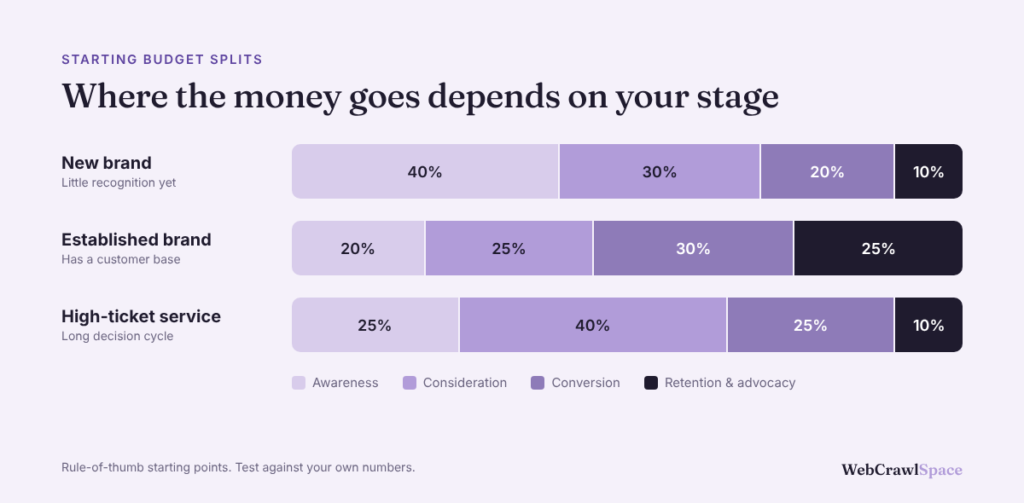
The logic behind these splits:
- A new brand has no demand to harvest yet, so it has to create some.
- An established brand already has customers, so retention earns its share.
- High-ticket services live or die on trust, so consideration gets the most.
Review Monthly, Shift Quarterly
Look at your stage KPIs every month, but only move budget meaningfully once a quarter. Upper-funnel spend takes weeks to show up in sales, and cutting it after one quiet month is how most brands end up back on bottom-only spend. When a stage consistently beats its KPI, give it a bit more. When a bridge is broken, fix the bridge before adding money.
Full-Funnel Examples for Malaysian Businesses
Here’s how the same framework adapts to three very different businesses.
A Neighbourhood Café in Petaling Jaya
- Awareness: Reels and TikToks of signature dishes, a Google Business Profile with fresh photos, and collaborations with local food creators.
- Consideration: Google reviews answered promptly, a menu that loads fast on mobile, and Instagram highlights covering hours, parking and halal status.
- Conversion: Click-to-WhatsApp ads for reservations and catering, links to delivery apps, and a first-visit set offer.
- Retention: An opt-in WhatsApp broadcast list for new menu items, and a stamp-card loyalty scheme.
- Advocacy: A Google review link or QR code on the table, shared after the meal.
A Property Agent in the Klang Valley
- Awareness: Area guides ranking for “living in [township]” searches, and walkthrough videos of new launches.
- Consideration: A downloadable price comparison of nearby projects in exchange for a WhatsApp number, plus testimonials from past buyers.
- Conversion: A viewing-booking landing page for each project, and fast WhatsApp responses during evenings and weekends.
- Retention: Check-ins after handover, and market updates for owners who may sell or upgrade later.
- Advocacy: A referral fee or gift for introductions, and permission to share buyers’ success stories.
The consideration stage carries this funnel. Property decisions take months, so the agent who stays helpfully in touch usually wins over the one with the best first ad.
An Online Skincare Brand
- Awareness: Creator reviews, before-and-after content, and Shopee and TikTok Shop listings.
- Consideration: Ingredient explainers, skin-type quizzes that capture an email, and retargeting ads showing real customer reviews.
- Conversion: Bundles for first-time buyers, free-shipping thresholds, and cart-abandonment emails.
- Retention: Replenishment reminders timed to when a bottle typically runs out, and routine tips after purchase.
- Advocacy: Review incentives on the next order, and reposting customer content with permission.
Common Full-Funnel Mistakes
- Spending everything on conversion ads: It feels efficient until demand runs dry and costs rise. Keep at least some budget creating new demand.
- No retargeting between stages: Most people won’t buy on their first visit. Without retargeting or a way to capture contact details, every click is a one-shot chance. Sequence your retargeting ads by stage, so a video viewer sees proof and a cart abandoner sees a reminder.
- Judging every stage on sales: Awareness content will always look bad on a last-click report. Use stage-appropriate KPIs.
- Treating email and WhatsApp as optional: These are the channels you own. Ad platforms can change prices and rules overnight, but your subscriber list stays yours.
- Building stages without bridges: A great blog and a great landing page with nothing connecting them are two separate projects, not a funnel.
Your Full-Funnel Planning Checklist
Copy the table below into a doc or spreadsheet and fill in one row per stage. If a cell is empty, that’s where your funnel is leaking.
Before you launch, run through this list:
Full-funnel launch checklist
FAQ
What is the difference between a marketing funnel and a full-funnel strategy?
A marketing funnel is the model: the stages people pass through before and after buying. A full-funnel strategy is the plan that puts deliberate marketing at every one of those stages and connects them, rather than focusing only on the final sale.
How many channels should a small business use per funnel stage?
One or two. It’s better to run fewer channels consistently than to spread a small team across many. Add a channel only when the existing ones are working and you have the capacity to maintain another.
How long does it take to see results from full-funnel marketing?
Conversion and retention improvements can show up within weeks. Awareness and SEO work usually take two to six months to feed meaningfully into sales. That’s why it helps to judge each stage on its own KPI while the upper funnel matures.
What KPIs should I track at each stage of the funnel?
- Awareness: reach and new visitors
- Consideration: leads and subscribers
- Conversion: conversion rate and cost per acquisition
- Retention: repeat purchase rate and lifetime value
- Advocacy: reviews and referrals
Is full-funnel marketing worth it for a small budget?
Yes, and arguably more so. A small budget can’t afford to waste clicks, and the full-funnel approach makes each click work harder through retargeting, contact capture and repeat sales. Start with the cheapest gaps first, which are usually a way to capture contact details and a simple post-purchase flow.