Google November Core Update 2026: What We Know and What to Do
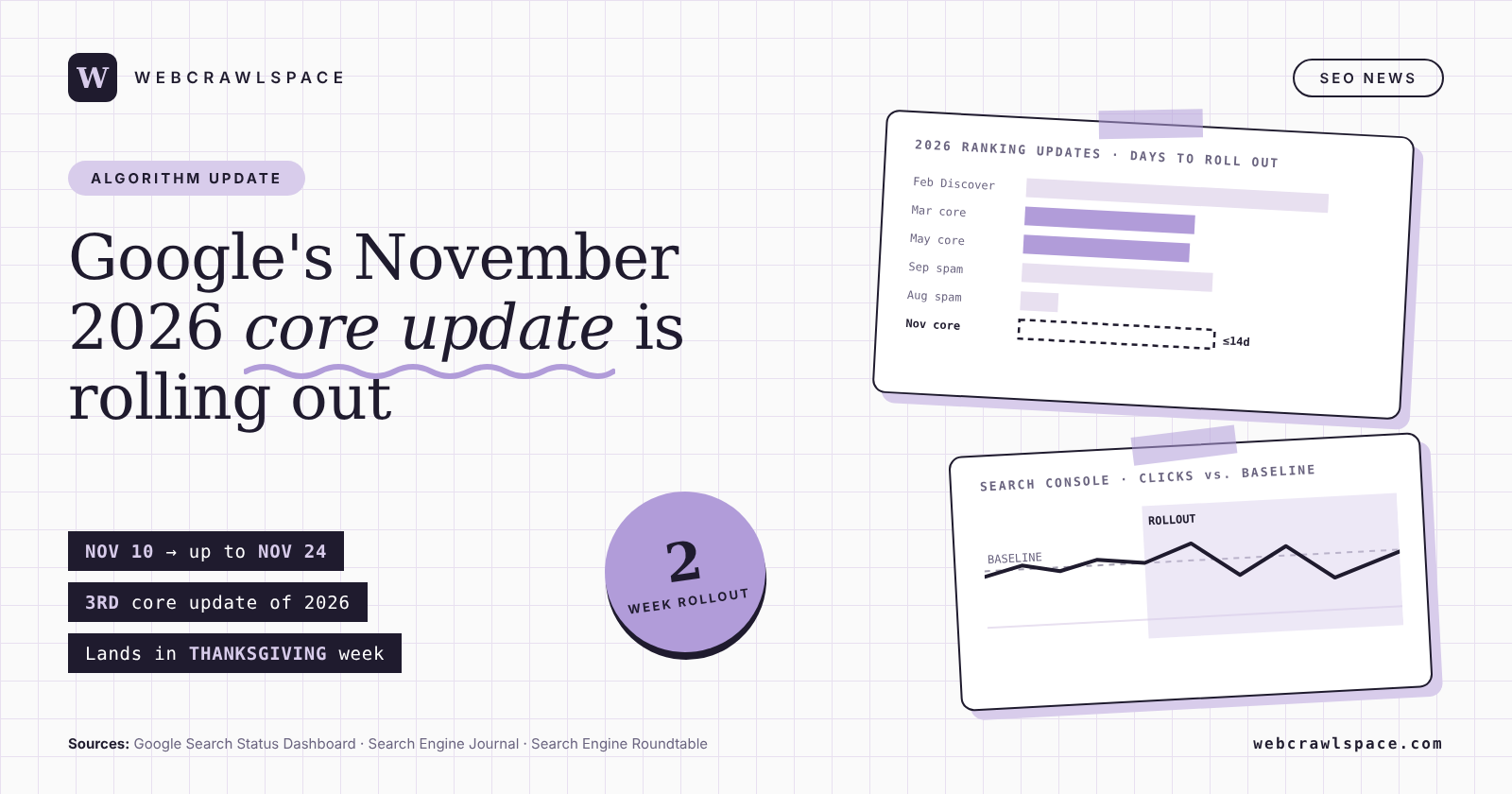
Google started rolling out its November 2026 core update on November 10, and says it may take up to two weeks to finish. The Google Search Status Dashboard logs the release at 10:07 a.m. Pacific, applying globally and to all languages.
It is Google’s third core update of 2026 and the eighth ranking update on the dashboard this year, according to Search Engine Journal. It also ends a long quiet spell: the May core update finished on June 2, more than five months earlier, and only spam updates ran in between (including the September 2026 ranking shake-up we covered earlier).
Google’s framing is routine. It calls this a regular update meant to better surface relevant, satisfying content from all types of sites, and it has not named any specific goal for it.
The practical issue is timing. Rankings can keep moving until roughly November 24, and that window runs straight into U.S. Thanksgiving, Black Friday and Cyber Monday.
Google’s 2026 ranking updates so far
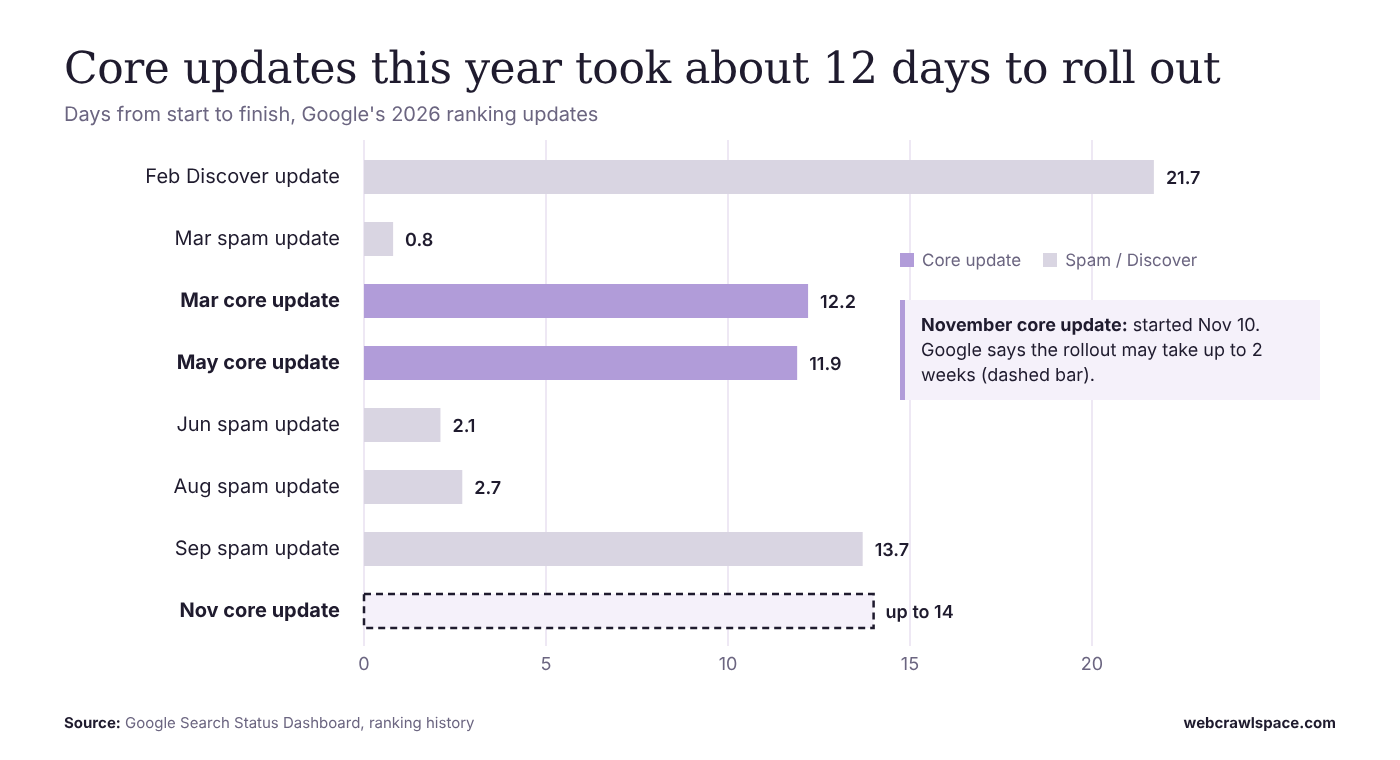
The November release is the first core update since May. Both earlier core updates this year took about 12 days to roll out, so a finish close to Google’s two-week estimate is plausible.
| Update | Type | Started | Duration |
|---|---|---|---|
| November 2026 core update | Core | Nov 10 | Rolling out (up to 2 weeks) |
| September 2026 spam update | Spam | Sep 24 | 13 days, 16 hours |
| August 2026 spam update | Spam | Aug 18 | 2 days, 16 hours |
| June 2026 spam update | Spam | Jun 24 | 2 days, 1 hour |
| May 2026 core update | Core | May 21 | 11 days, 21 hours |
| March 2026 core update | Core | Mar 27 | 12 days, 4 hours |
| March 2026 spam update | Spam | Mar 24 | 19 hours, 30 minutes |
| February 2026 Discover update | Discover | Feb 5 | 21 days, 17 hours |
Source: Google Search Status Dashboard, ranking history. By PPC Land’s count, 173 days separate the May and November core updates, the longest gap between core updates this year.
What Google has and hasn’t said
Google has said very little beyond the basics. The announcement wording matches what Google used for the March core update, and that neither the dashboard entry nor Google’s LinkedIn post states any specific objective.
Three gaps are worth knowing about:
- No new guidance: Google has not published advice specific to this update. Its core updates page still carries a December 10, 2025 revision date.
- Scope is unclear: PPC Land points out that Google has not said whether the update touches Discover or AI features as well as web results.
- Finish line is an estimate: “Up to two weeks” is a ceiling, not a promise, and Google says it will update its ranking release history once the rollout ends.
Google’s standing position is that core updates do not target specific sites or individual pages. Search Engine Land adds that Google also ships smaller core updates without announcing them, which is one reason movement before a formal start date is hard to pin on any single change.
Early signals, and why to treat tracker data with care
Ranking tools were already moving before Google said anything. Search Engine Roundtable reported on November 9 that volatility looked set to pick up after a calm stretch that followed an unconfirmed update around October 27. Its announcement-day post says some in the industry had already felt the earlier movement looked like a core update, and that Google may run periodic refreshes of the algorithm without announcing them. Forum commenters described weak weekend traffic, which is anecdotal but fits the timing.
One caution applies to every volatility chart you look at this week. Since mid-September, rank-tracking vendors have been reporting that Google serves their scrapers normal-looking results pages with many of the usual sites swapped out. Nozzle’s study puts the share at 68.6% of judged SERPs on November 2 when page one and page two are counted together, and 15.0% for page one alone since September 13, per the Keywords Everywhere change log (listed in Sources below). Semrush, Ahrefs and AccuRanker have all acknowledged the problem, and Google has not commented.
That makes third-party volatility readings and rank-tracker drops a weaker signal than usual. Search Console is Google’s own data, so it is the safer place to confirm a real change. One data note there: the same log records unexplained click spikes on some sites on November 3, which commentators suspected were bot traffic or a bug.
How to measure the impact
Google’s own advice is to wait. It also recommends holding off on Search Console analysis until the rollout is complete, then waiting at least another full week. After that, compare that week against the week before the rollout began. For this update, that baseline is the week before November 10.
This time the standard method has a flaw. A rollout that runs to about November 24 means the post-update week lands on U.S. Thanksgiving (November 26), Black Friday (November 27) and Cyber Monday (November 30).
Search Engine Journal points out that retail sites would be comparing holiday traffic against a normal week, which says little about the update itself.
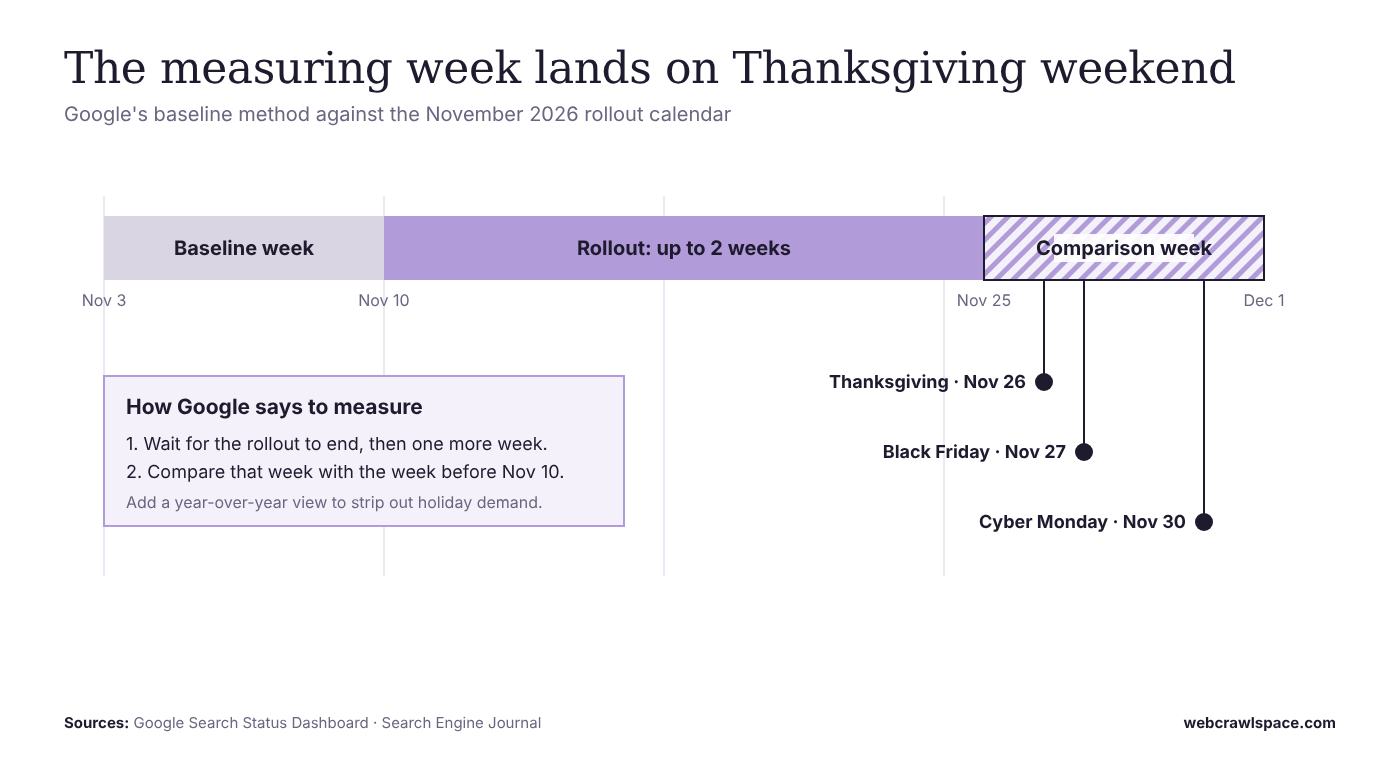
Two adjustments keep the comparison honest:
- Add a year-over-year view for the same dates, so seasonal demand is not mistaken for a ranking change.
- Look at queries and pages, not just totals: Compare clicks, impressions and average position for non-branded queries and for individual page groups. A site-wide dip in clicks with stable positions usually points to demand, not ranking.
What to do, and what to hold off on
Google has not issued guidance specific to this update, so the steps below follow its standing advice on core updates plus the measurement issues above.
- Hold major changes until the rollout ends: Google suggests waiting before drawing conclusions from Search Console, and rankings can still shift until about November 24.
- Save a baseline now: Export Search Console queries and pages for the week before November 10, and note the rollout dates in your reporting so later swings can be tied to them.
- Use Search Console, not rank trackers, to judge movement: Given the tracker data problems, a drop in a third-party tool needs confirming against clicks, impressions and average position.
- Rule out technical causes first: A core update does not by itself indicate a crawling or indexing problem, so check robots.txt, server errors and the indexing report before blaming the update.
- If you drop, review content, not just technicals: Google’s position is that core updates do not penalize sites, and our guide to recovering from a Google spam update separates the myths from what actually works. A December 2025 change to its documentation clarified that sites that improve their content can regain position without waiting for the next major core update.
- Avoid knee-jerk rewrites or mass deletions: Compare after the full week Google recommends, segment by page group and query type, and fix what the data shows rather than everything at once.
Crawl-side changes from recent weeks (separate from the core update)
If you saw “crawl” and “update” in the same headline this month, it may have been one of these documentation changes rather than the core update. None of them is a ranking update, and none has a Search Status Dashboard entry.
- Page indexing report wording (around November 3): Google rewrote its help text for the “Crawled – currently not indexed” status. It now says the status is common and does not necessarily signal a problem, and points owners of important pages to the URL Inspection tool.
- Retry-After in the crawl rate docs (October 6): Google restructured its emergency crawl rate reduction section and added Retry-After header examples for 503 and 429 responses, saying support for the header is not new (Google crawling changelog).
- Crawling and indexing timelines: Google shared typical timings, as summarized by Numinix – new URL discovery in about 20 hours, indexing in about 1.5 hours once processing begins, and site moves taking one to three months.
- Crawl budget wording (July): Google’s revised page says every site starts from the same conservative default crawl capacity limit.
- The 2 MB Googlebot limit (February): Google’s docs now state that Googlebot crawls the first 2 MB of a supported file and the first 64 MB of a PDF for Search. Google described this as a clarification, not a behavior change, against a 15 MB default for its crawlers generally.
For a wider look at what changed last month, see our October 2026 Google Search recap. The practical overlap with the core update is small. Healthy crawling and indexing are a precondition for ranking, but they are not what this update is about.
Bottom line
The November 2026 core update is a routine-labelled but broad change that lands in the middle of the shopping season, while third-party ranking data is unusually noisy. Save a Search Console baseline, avoid reacting to early swings, and judge the result only after the rollout ends and a full week has passed. This article reflects what was known on November 11, 2026, with the rollout still in progress.
Sources
- Google Search Status Dashboard: November 2026 core update
- Google Search Status Dashboard: ranking history
- Search Engine Journal: Google’s November 2026 Core Update Starts Rolling Out
- Search Engine Land: Google November 2026 core update rolling out now
- Search Engine Roundtable: Google November 2026 Core Update Is Rolling Out
- Search Engine Roundtable: Google Search Ranking Volatility Status, November 8th/9th
- PPC Land: Google’s core update shifts rankings for up to 2 weeks before Black Friday
- Keywords Everywhere: Search Console and Googlebot changes
- DEV Community: What to monitor during the November 2026 core update
- Numinix: November 2026 SEO News & Google Algorithm Updates
- Search Engine Journal: Google Updates Googlebot File Size Limit Docs
- SEO-Day: Google updates its crawl budget doc
- Google Search Central: Latest documentation updates
- Google crawling documentation changelog