October 2026 Search Recap: 7 Google Changes SEOs Can’t Ignore
September 2026 gave site owners a spam update, two new ways to slice Search Console data, a paid program for AI citations, and a pair of reporting scares that turned out to be temporary. If you only had time to skim the headlines, this recap pulls the month together and explains what each change means for the sites you manage.
We publish free public site audits every month, so we see how these updates land on real websites rather than in press releases. That perspective shapes the advice below. For each change you will find what happened, what Google has actually confirmed, and the one or two actions worth taking this week.
Key dates · 28 Aug to 1 Oct 2026
Some AI Overviews now show the full answer straight away, with no Show more button
Key change
Search Console AI performance reports reach every site worldwideAI Mode switches to Gemini 3.8 Flash
Publishers report articles missing from the News tab
Brief Search Console indexing report glitch, confirmed by Google the next day
Sponsored text links spotted inside AI Mode answers
Details emerge on the AI Contribution pilot that pays publishers
Share of AI Overviews with inline external links peaks at 26.2%
Key change
September 2026 spam update begins, and a multimodal filter is added to Search ConsoleGoogle refreshes its guidance on generative AI content
1. The September 2026 Spam Update Is Still Rolling Out
The biggest story of the month started on 24 September, when Google announced a new spam update on its Search Status Dashboard. Google has confirmed only a handful of facts: it applies globally, it covers every language, and the rollout may take up to two weeks. As of 2 October 2026, eight days into the rollout, Google has not marked it complete.
Just as important is what Google has not said. There is no named spam tactic, no targeted industry, and no statement that content generated by AI is a standalone target. Many of the hot takes you will see on social media fill that gap with guesses. Treat any claim that goes beyond the dashboard wording as opinion until Google adds detail.
Spam updates have also become very uneven in length. The March 2026 spam update finished in under 20 hours, the shortest in the dashboard’s history, while core updates this year have needed close to two weeks. The chart below puts recent rollouts side by side so you can judge where this one sits.
What to Do This Week
- Annotate 24 September in your analytics and Search Console exports so later comparisons start from the right date.
- Hold off on sitewide changes until the update completes. Rankings often swing back and forth during a rollout.
- Once it finishes, compare a full week before and after, page by page, and look for clusters of templated or thin pages that dropped together.
2. Search Console AI Performance Reports Are Now Available to Every Site
Google first introduced the generative AI performance report on 3 June 2026, starting with a limited group of properties. On 31 August the Search Console help page was updated to say the report has reached all websites worldwide. There are two versions: one for Search, covering AI Overviews and AI Mode, and a separate one for Discover.
The report counts impressions, meaning how often a URL from your site appeared inside an AI feature. You can break that down by page, country, device and date. It does not tell you how many people clicked through, so it is best read as a visibility report rather than a traffic report.
One detail clears up a lot of confusion. Google has confirmed that AI impressions were always part of the overall Performance totals. Nothing new was added to your headline numbers; the launch simply separates that slice so you can see it. If your total impressions did not jump on 31 August, that is expected.
Google’s John Mueller has also said that position and impression tracking for AI surfaces will keep evolving, and that citation counting has edge cases. Expect the numbers to shift as the methodology matures, and avoid promising clients precise AI visibility targets based on a few weeks of data.
3. A New Multimodal Filter Shows Traffic From Image Searches
On 24 September, Search Console split the Web search type in the Performance report into two options: one for text searches and one for multimodal searches. The multimodal view covers searches that start with an image, including Google Lens, Circle to Search on Android, photo uploads to Google Search, and the Search this image option in Chrome.
There is a catch. Because these searches begin with a picture instead of typed words, there is no query data. You will see impressions, clicks and average position, but not the searches that triggered them. Google also groups every image entry point together, so you cannot tell Lens traffic apart from Circle to Search traffic. Some properties show multimodal data reaching back to around 10 September.
The filter appears in both the standard Search results report and the generative AI report, which means you can see when a search that started with an image surfaced your page inside an AI answer.
- Check which pages earn multimodal impressions. Product pages, recipes, tutorials and local business pages are likely candidates, while sites built around typed searches may see very little.
- Prioritise original photography and screenshots over stock images, since visual search matches what it sees.
- Add a multimodal line to your monthly client reports now, even if the numbers are small, so you have a baseline later.
First party data
What We Saw Across Our Sites
We checked the new reports on the sites we run in Malaysia. These are early numbers from a single month, but they give us a baseline to track.
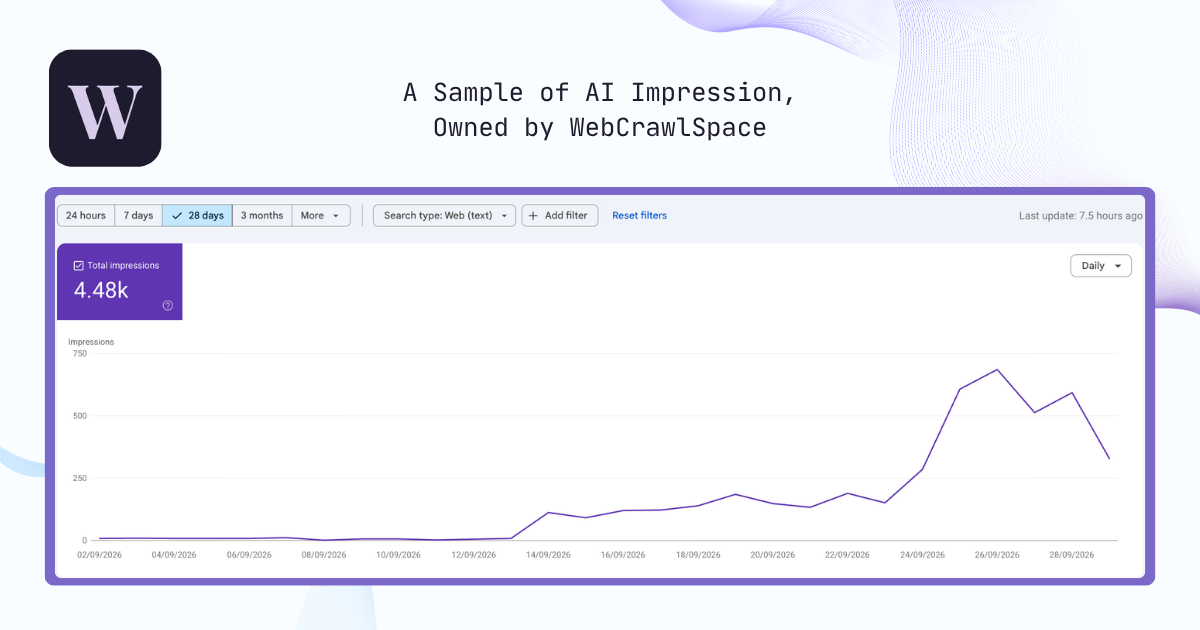
- <0.1%of AI impressions came from searches that started with an image
- 4.6×rise in daily AI impressions between 23 and 26 September, on one site in our sample
4. Google Is Testing Payments for Content That Shapes AI Answers
Reporting in mid September described an AI Contribution pilot inside Search Console. Publishers in the program are paid when their content meaningfully contributes to an answer in AI Overviews, AI Mode or Gemini. Earnings appear in a dedicated panel that shows a monthly figure with some history.
The pilot is invite only and covers a small group of publishers. Early accounts suggest the payouts are modest, and Google has not explained how amounts are calculated. For most site owners this is not something to plan revenue around yet.
It still matters as a signal. Google is building infrastructure to measure which pages feed its AI answers, and that measurement now exists in three places: the AI performance report, the multimodal filter and this earnings panel. Content that is specific, well sourced and easy to quote is the content that gets counted.
5. AI Overviews Are Turning Into a Doorway to AI Mode
Late August brought a visible shift in how AI Overviews behave. Until then, searchers saw a short AI answer and had to click Show More to read the rest. From 28 August, Google started showing the full answer straight away for some searches. The Show more button disappeared, and a box inviting searchers to ask another question now sits below the answer. That design nudges searchers to keep asking questions inside AI Mode instead of scrolling to the organic results.
Links inside the answer text changed too. Data from Peec AI showed the share of AI Overviews containing an external link in the answer stayed close to zero until around 10 September, then climbed to 26.2% by 20 September. That sounds like good news for publishers, but other observers found that some of those inline links open a new AI Mode query rather than a website. Not every blue link in an overview is a path to your site.
Behind the scenes, AI Mode moved to Gemini 3.8 Flash on 2 September, and Google was spotted on 15 September testing sponsored text links woven into AI Mode answers with a Sponsored label. If you manage ads, keep an eye on that test in our paid search category, because it could become a new placement type. For the organic side, our AI Search coverage tracks how these surfaces choose and display sources.
6. An Indexing Report Glitch Caused a Short Scare
On 8 September, Search Console briefly showed many pages as Crawled, currently not indexed. The problem cleared within about an hour, and the next morning John Mueller confirmed it had been a short reporting blip rather than a real change to the index.
The lesson is about timing. Anyone who pulled data through the Search Console API during that window may have stored misleading statuses in a dashboard or spreadsheet. If your automated reports ran that evening, rerun them or exclude that day before sharing results.
For quick reassurance during future scares, use the URL Inspection tool on your homepage and a few key pages. If those show as indexed, a sudden spike in excluded pages is far more likely to be a reporting issue than a deindexing event.
7. News Content Went Missing From the News Tab
In the first days of September, publishers noticed that some articles were crawled, indexed and visible in the main results but absent from the News tab, sometimes reappearing hours later. The pattern looked random and affected both large and small outlets. Forum threads on WebmasterWorld described wider delays in Google News inclusion beginning around 1 September, along with unusually volatile Discover feeds.
Google did not announce a cause. If your site depends on news traffic and you saw a dip in early September, compare News tab and Discover performance separately from web search before blaming content quality.
Also Worth Knowing: Updated Guidance on AI Content
On 1 October, Google refreshed its documentation on using generative AI content, bringing it into line with material from the Search Quality Rater Guidelines. The core message has not changed. Using AI is acceptable, while publishing large volumes of unoriginal pages mainly to manipulate rankings is not. Google also said last month that it can lose trust in a site that publishes low value programmatic pages, so the risk reaches beyond the weak pages themselves.
Your October Action List
- Mark 24 September in every report and wait for the spam update to complete before reacting.
- Open the generative AI report, export the Pages tab, and compare it with your top organic pages.
- Turn on the multimodal filter and record a baseline for visual search traffic.
- Rerun any API exports taken on 8 September.
- Audit thin, templated or bulk published pages against Google’s refreshed AI content guidance. Our Zanroo site audit shows the kind of checks we run on a real site.
Conclusion
September’s changes point in one direction. Google is measuring AI visibility in more detail than ever, through dedicated reports, a multimodal view and even a payment pilot, while making its AI answers stickier with expanded overviews and links that lead deeper into AI Mode. At the same time, the spam update is a reminder that the basics still decide who stays visible.
The sites that will come out ahead are the ones that track AI impressions alongside clicks, publish specific content backed by clear evidence, and stay calm when a reporting glitch or a rollout causes temporary noise. Check back next month for the November recap.
Frequently Asked Questions
When did the September 2026 spam update start, and how long will it last?
It began on 24 September 2026. Google says the rollout may take up to two weeks, so it could finish around early October. Wait for the completion note on the Search Status Dashboard before comparing before and after data.
Why can’t I see the generative AI report in Search Console?
The report reached all sites on 31 August 2026, but it only appears when your property has enough impressions in AI features. It will also be missing if your site has been excluded from Search generative AI features through the related control.
Do AI impressions inflate my total Search Console impressions?
No. Google has confirmed AI impressions were always counted in the overall Performance totals. The new report separates that slice so you can analyse it, without adding anything to your headline figures.
Why does the multimodal filter show no queries?
Multimodal searches begin with an image, photo or screenshot instead of typed text, so there is no text query to report. You still get impressions, clicks and average position for the pages that appeared.
Can any publisher join Google’s AI Contribution pilot?
Not at the moment. The pilot is invite only and limited to a small group of publishers. Google has not shared how payouts are calculated or when, or whether, the program will open more widely.