Does AI Contribute to Memory Loss and Critical Thinking?
Not one of the 18 people who wrote an essay with ChatGPT in an MIT Media Lab experiment could correctly quote a single line of it minutes later. Most writers who used a search engine or no tool at all could. That finding has fuelled a growing debate about whether artificial intelligence (AI) is changing the way we think, remember and process information.
I came back to this question after attending the Become AI-Native with Grok Bot x Notion meetup at Sandbox Coworking Space in Sunway on 6 November. One attendee raised an interesting point: compare the hours it takes to design a presentation manually with the minutes it takes to generate one using AI. While the technology saves time, it may also remove much of the creative and critical thinking that normally happens during the process.
It is a concern worth taking seriously, especially as AI becomes part of everyday work, education and decision-making, and as AI search is changing how marketers work.
But does AI actually affect memory? Can using ChatGPT reduce critical thinking skills? And does relying on AI too often make people less capable of thinking independently?
The answer is more complicated than simply saying AI makes us less intelligent. Research suggests that the way we use AI matters just as much as how frequently we use it. When AI supports our thinking, it can improve productivity and learning. When it replaces the thinking process entirely, it may reduce how much we retain, understand and evaluate independently.
Here is what the research actually shows, what it does not prove, and how to use AI without becoming overly dependent on it.
- AI does not automatically damage memory or intelligence. However, relying on it to complete thinking tasks may reduce how much information we actively process and remember.
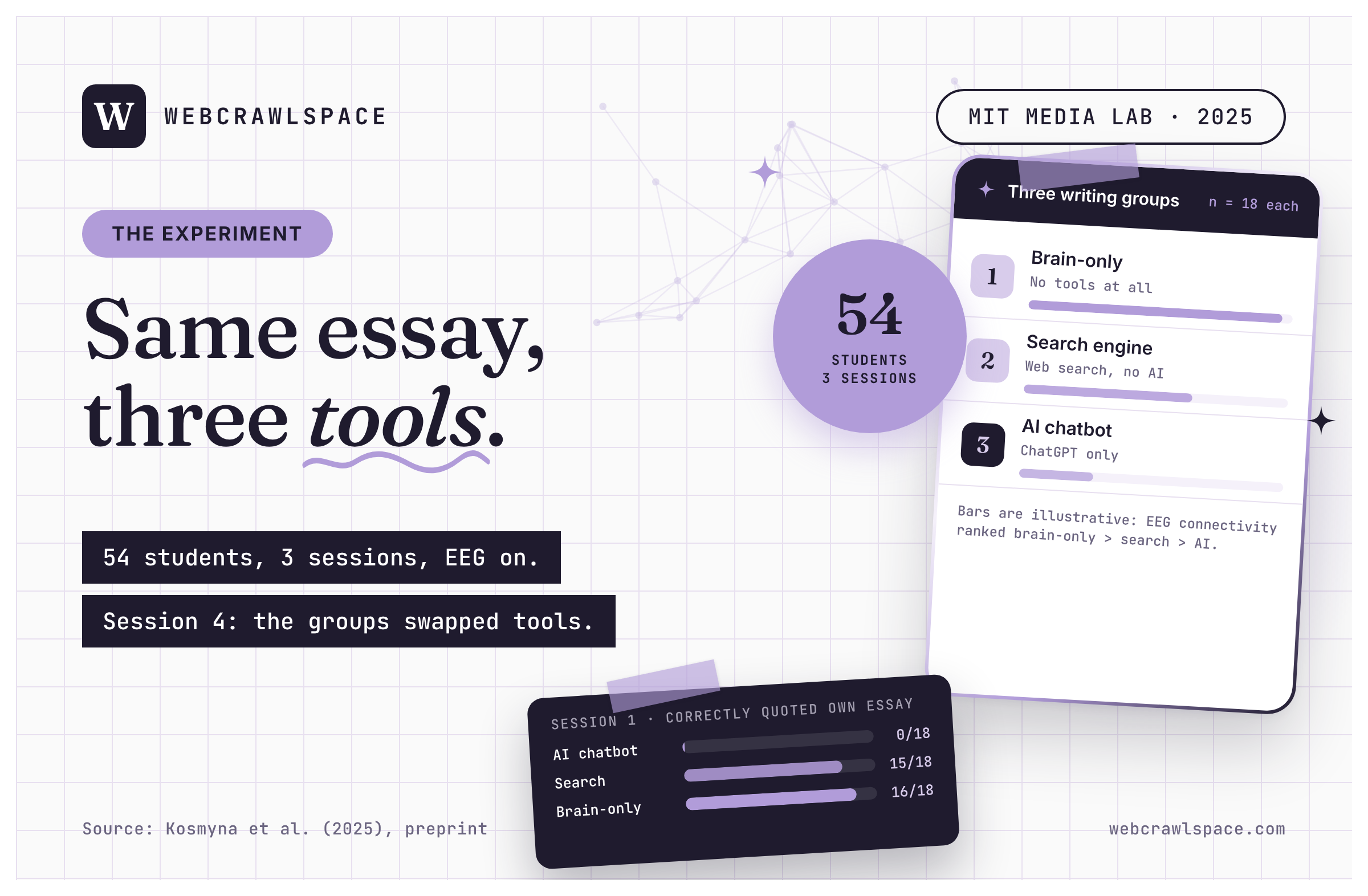
- An MIT Media Lab experiment found that none of the 18 ChatGPT users in a recall test could correctly quote their own essay, compared with 15 of 18 search-engine users and 16 of 18 participants who worked without tools.
- Microsoft and Carnegie Mellon researchers found that greater confidence in generative AI was associated with less reported critical thinking effort among knowledge workers.
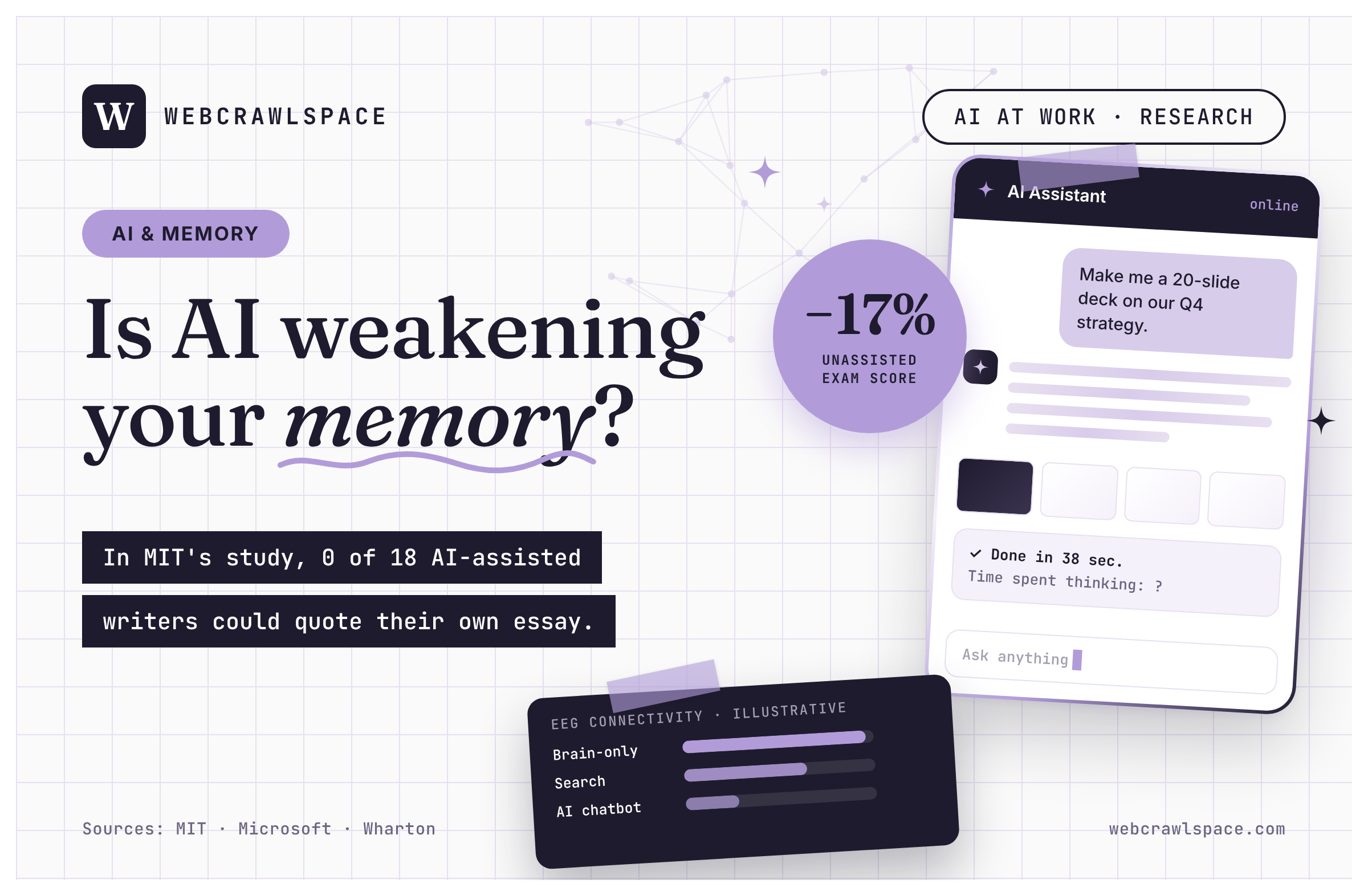
- A Wharton field experiment found that students using unrestricted AI performed better during practice but scored 17% lower on an unassisted exam than students who did not use AI.
- More recent research suggests that AI can either support or replace higher-order thinking, depending on how the technology is designed and used.
- The best approach is not to stop using AI. It is to think independently first, use AI to improve your reasoning, and verify the results yourself.
How does AI affect the human brain?
Artificial intelligence is changing how people approach everyday cognitive tasks, including writing, researching, remembering information and solving problems.
To understand why this matters, it helps to look at a concept known as cognitive offloading.
What is cognitive offloading?
Cognitive offloading refers to using external tools or resources to reduce the mental effort required to complete a task.
It is something people have done long before generative AI existed. For example:
- Writing down a shopping list instead of remembering every item.
- Using Google Maps instead of memorising directions.
- Saving someone’s phone number instead of recalling it.
- Searching Google for information instead of remembering the answer.
These examples are not necessarily harmful. External tools allow people to manage information more efficiently and free up mental resources for other tasks.
Research has also shown that people adjust what they remember depending on whether they expect to access information again. In a 2011 study published in Science, Betsy Sparrow and colleagues found that people who expected information to remain accessible tended to remember where to find it rather than the information itself. This became known as the Google Effect.
The same principle can be seen with photography. In a 2014 study, Linda Henkel found that people who photographed entire objects during a museum visit remembered fewer objects and details than those who simply observed them. However, zooming in on specific details reduced this effect, suggesting that attention played an important role.
A 2020 study by Dahmani and Bohbot also linked heavier lifetime GPS use with weaker spatial memory when participants navigated without GPS assistance.
Generative AI introduces another layer to this behaviour. Unlike a search engine, which provides links for users to investigate, AI can generate a complete response. It can write an essay, summarise research, create a presentation, recommend a strategy or explain a complicated concept. This changes the amount of work people need to perform themselves.
The difference is important:
- Traditional cognitive offloading: using a tool to help retrieve or store information.
- AI-assisted cognitive offloading: using AI to process, organise or generate information.
- Cognitive substitution: allowing AI to perform the reasoning or decision-making that a person would otherwise need to do.
The last example is where overreliance becomes a concern. If someone consistently accepts AI-generated answers without questioning or understanding them, they may complete tasks without developing the knowledge or skills those tasks were supposed to build.
Does using ChatGPT affect your memory?
One of the most widely discussed studies on AI and memory comes from the MIT Media Lab.
The MIT Media Lab study: 54 writers, three tools and one recall gap
The 2025 study, titled Your Brain on ChatGPT: Accumulation of Cognitive Debt when Using an AI Assistant for Essay Writing Task, examined how different writing methods affected brain activity and memory. Researchers divided 54 university students into three groups:
- ChatGPT group: participants used an AI chatbot to write essays.
- Search-engine group: participants used a traditional search engine.
- Brain-only group: participants wrote without external tools.
Each group completed three essay-writing sessions. Researchers also used electroencephalography (EEG) to measure patterns of brain activity during the task. The most attention-grabbing result came from a recall test.
MIT study: participants who correctly quoted their own essay
Session 1, 18 participants per group
The findings suggested that participants who relied on ChatGPT engaged differently with the writing process and had poorer recall of the content they had produced.
The researchers also observed differences in EEG connectivity. Participants who wrote without external assistance showed the strongest connectivity, followed by search-engine users and then ChatGPT users.
However, the study did not establish that ChatGPT permanently damages memory or reduces intelligence.
What happened when participants switched tools?
An additional fourth session involved 18 participants from the original study. Participants switched conditions. Those who previously used ChatGPT wrote without it, while those who had previously written without tools were given access to ChatGPT.
The researchers observed differences between the groups. Participants who moved from ChatGPT-assisted writing to unaided writing struggled with recalling their previous work. Meanwhile, participants who initially wrote without AI and subsequently used ChatGPT showed stronger recall than those who had relied on AI from the beginning.
This suggests that the order in which people use AI may matter. Thinking through a problem independently before asking AI for assistance could encourage greater engagement with the material.
Limitations: the fourth session involved only 18 participants, with just nine in each switching group, and the research focused on essay writing rather than memory performance across everyday activities. The paper is available as an MIT Media Lab research publication and an arXiv preprint. Its findings should be treated as preliminary evidence rather than proof of lasting cognitive decline.
Does AI reduce critical thinking skills?
Memory is only one part of the discussion. Another concern is whether people become less capable of analysing information, questioning assumptions and making independent decisions when they rely heavily on AI.
Critical thinking involves more than knowing whether an answer is correct. It requires people to:
- Evaluate the reliability of information.
- Identify assumptions and potential biases.
- Compare different explanations.
- Recognise contradictions.
- Form their own conclusions.
- Explain and defend their decisions.
AI can assist with these activities, but it can also make it easier to skip them.
What Microsoft and Carnegie Mellon research found
A 2025 study by researchers from Microsoft Research and Carnegie Mellon University examined how generative AI affects critical thinking among knowledge workers. The researchers surveyed 319 people who used generative AI at least weekly and analysed 936 examples of AI-assisted work. Two findings stood out.
First, workers who expressed greater confidence in AI tended to report less critical thinking effort when using it. Second, workers were more likely to engage in critical thinking when they needed to evaluate the quality of AI-generated information. In other words, people were more likely to question AI when they had the knowledge and ability to assess its output.
This creates an interesting problem for workplaces. Imagine two marketers using AI to develop an SEO strategy.
The first marketer understands keyword research, search intent, technical SEO and content strategy. They can use AI to generate recommendations, identify opportunities and challenge their existing ideas.
The second marketer has limited SEO experience. They may receive the same recommendations but lack the knowledge to identify incorrect assumptions, irrelevant keywords or technically flawed suggestions.
Both may produce a strategy quickly, but the quality of their decision-making can be very different.
The research suggests that the ability to evaluate AI output is an important part of using the technology effectively. It also highlights a potential shift in professional skills: people may spend less time executing tasks and more time reviewing and supervising AI-generated work. Building a live dashboard with AI is a good example, since the tool saves hours of setup while you still decide what the numbers mean. You can see that division of labour in our Google Ads dashboard in Claude guide.
However, effective supervision still requires expertise. If people gradually lose the ability to perform or understand the underlying tasks, they may also become less capable of evaluating the results.
The research was based on self-reported survey responses, so it does not establish that AI use directly causes a decline in critical thinking ability. Read the Microsoft Research and Carnegie Mellon study.
What does recent research say about AI and cognitive decline?
Research published in 2025 raised concerns about AI dependence, but newer studies in 2026 provide a more nuanced picture. Rather than suggesting that AI is always harmful, these studies explore how different patterns of AI use influence learning, memory and higher-order thinking.
1. A 2026 systematic review of 89 studies
A 2026 systematic review published in Frontiers in Psychology, titled Amplifier or Substitute? A Systematic Review of Generative AI’s Impact on Higher-Order Cognitive Skills Among University Students, examined 89 peer-reviewed studies published between 2024 and 2026. The review explored how generative AI affected skills such as:
- Critical thinking.
- Creative thinking.
- Problem-solving.
- Analytical reasoning.
- Independent learning.
The researchers found that AI’s effects were not consistently positive or negative. Positive outcomes were reported in 40.4% of the studies, while 23.6% reported mixed or conditional effects. Overreliance was the most frequently identified cognitive risk, followed by reduced analytical autonomy and cognitive offloading.
The review proposed an important distinction: generative AI can act as a cognitive amplifier when it supports independent thinking, but it can become a cognitive substitute when people depend on it to perform the reasoning themselves. Using AI to challenge an argument or explain an unfamiliar concept is different from asking it to complete an assignment without understanding the answer.
Read the 2026 systematic review.
2. When AI thinks for us: the effects of ChatGPT overreliance
A 2026 study by Zeineb Farhat, published in Applied Cognitive Psychology, examined how regular ChatGPT users perceived its effects on their thinking and behaviour. The research involved qualitative interviews with 45 regular users. Participants reported several concerns, including:
- Weaker memory retention.
- Reduced critical thinking.
- Greater dependence on AI.
- Reduced sense of autonomy.
- Lower intrinsic motivation.
However, the study also identified people who used ChatGPT constructively to support creativity and reflective learning.
The findings were based on interviews and participants’ reported experiences, rather than controlled measurements of long-term memory loss. They therefore provide insight into how people experience AI dependence, not proof that ChatGPT causes permanent cognitive decline.
Read the study, When AI Thinks for Us.
3. A 2026 review of AI and cognitive load
Another 2026 systematic review published in Frontiers in Psychology examined 39 empirical studies on generative AI and cognitive load in education. Cognitive load refers to the mental effort required to process information and complete a learning task. The review found that the effects of AI depended on factors such as:
- The design of the AI tool.
- The amount of AI assistance provided.
- The learner’s existing knowledge.
- Whether the task encouraged independent reasoning.
- How the AI was integrated into the learning process.
The researchers concluded that AI did not produce a uniformly beneficial or harmful effect. This supports the idea that using AI effectively requires more than simply giving people access to a chatbot. The way the tool is introduced and used can influence whether it supports learning or replaces important mental activities.
Read the 2026 cognitive load systematic review.
Can AI make you worse at learning?
One of the strongest examples of how AI can affect learning comes from a randomised field experiment involving nearly 1,000 high school mathematics students in Turkey. The 2025 study, published in the Proceedings of the National Academy of Sciences (PNAS), was led by researchers including Hamsa Bastani. Students were divided into three groups:
- A control group that practised without AI.
- A GPT Base group that used an unrestricted ChatGPT-style interface.
- A GPT Tutor group that used an AI tutor with safeguards designed to encourage learning rather than simply provide answers.
Performance with AI vs. performance without AI
| AI condition | Practice performance | Unassisted exam performance |
|---|---|---|
| GPT Base | +48% | −17% |
| GPT Tutor | +127% | Approximately 0% |
Changes are relative to the control group.
When AI was available, both groups performed significantly better during practice. However, when students had to complete an exam without AI assistance, those who used the unrestricted GPT Base interface scored 17% lower than students who had never used AI. The GPT Tutor group, which received prompts and safeguards encouraging independent reasoning, performed approximately at the same level as the control group.
Researchers found that students using the unrestricted interface frequently requested direct answers instead of working through the problems themselves. This meant that they could complete practice exercises successfully without necessarily understanding the underlying mathematical concepts.
The findings suggest that performing better with AI does not automatically mean someone has learned more.
Can AI actually improve learning?
There is also evidence that AI can improve learning when it is designed to support the learning process. A 2025 Harvard-led randomised controlled study published in Scientific Reports involved 194 undergraduate physics students. Researchers compared an AI tutor designed around established educational principles with an active-learning classroom approach. Students using the AI tutor achieved more than twice the median learning gains of students in the classroom comparison.
The tutor was specifically designed to provide personalised guidance and support learning rather than simply generate answers. This is an important counterpoint to the concerns surrounding AI dependence. AI is not inherently harmful to learning. It can be an effective educational tool when it encourages people to understand concepts, ask questions and work through problems.
The difference lies in whether AI is being used to help people learn or simply to help them finish a task.
Read the Harvard AI tutoring experiment.
Does AI cause cognitive decline or permanent memory loss?
Based on the research discussed above, there is not enough evidence to conclude that using ChatGPT or other AI tools causes permanent memory loss, brain damage or a general decline in intelligence. It is important to distinguish between several different concepts.
- Memory retention: how well someone remembers information after learning it.
- Cognitive offloading: using an external tool to reduce the mental effort required to complete a task.
- Critical thinking: the ability to evaluate information, identify problems and form independent conclusions.
- Cognitive debt: a term used by the MIT researchers to describe the potential accumulation of costs associated with repeatedly delegating cognitive work to AI.
These concepts are related, but they are not interchangeable. For example, someone who uses AI to summarise a research paper may remember fewer details because they did not engage with the original material. That does not necessarily mean their overall memory capacity has declined. Similarly, someone who regularly asks AI to solve problems may become less practised at solving those problems independently. This is different from demonstrating permanent damage to their brain.
The current evidence is more consistent with concerns about learning, engagement, reliance and skill development than with claims of irreversible cognitive damage.
The presentation question: designing for hours vs. prompting for minutes
Going back to the meetup, the presentation example is worth exploring further. Imagine spending several hours creating a presentation manually. You need to research the topic, identify the most important information, decide how to structure the story, choose which data deserves attention and work out how to communicate your findings. During this process, you are constantly making decisions.
You might remove a slide because the information is unnecessary. You might discover a more convincing argument while researching. You might change the order of your presentation because the original structure does not make sense.
Now imagine asking AI to generate the entire presentation. Within minutes, you have a complete deck with headings, content and a suggested storyline. The result may look polished, but how much of the underlying thinking did you actually perform?
This is where AI-assisted work can become cognitive substitution. The problem is not that AI created the presentation. The problem is when the person presenting it does not understand why the information was selected, how the argument was developed or whether the conclusions are accurate.
The same applies to marketers, analysts, writers and other knowledge workers. AI can save time on repetitive execution, but people still need to understand the decisions behind the output.
Offloading vs. augmenting your thinking
| Offloading thinking | Augmenting thinking |
|---|---|
| Asking AI to create an entire presentation without a plan | Developing the storyline before asking AI to improve it |
| Accepting the first answer without reviewing it | Challenging AI to identify weaknesses and missing information |
| Copying research without checking the sources | Verifying important claims independently |
| Using AI for tasks you do not understand | Learning the underlying concepts before automating them |
| Relying on AI to make every decision | Using AI to compare options before making your own decision |
The goal should not be to eliminate AI from the workflow. It should be to ensure that people remain actively involved in the thinking process.
How to use AI without losing your thinking skills
AI can be a valuable productivity tool, but it is important to develop habits that keep your own reasoning involved. Here are five practical ways to use AI without becoming overly dependent on it.
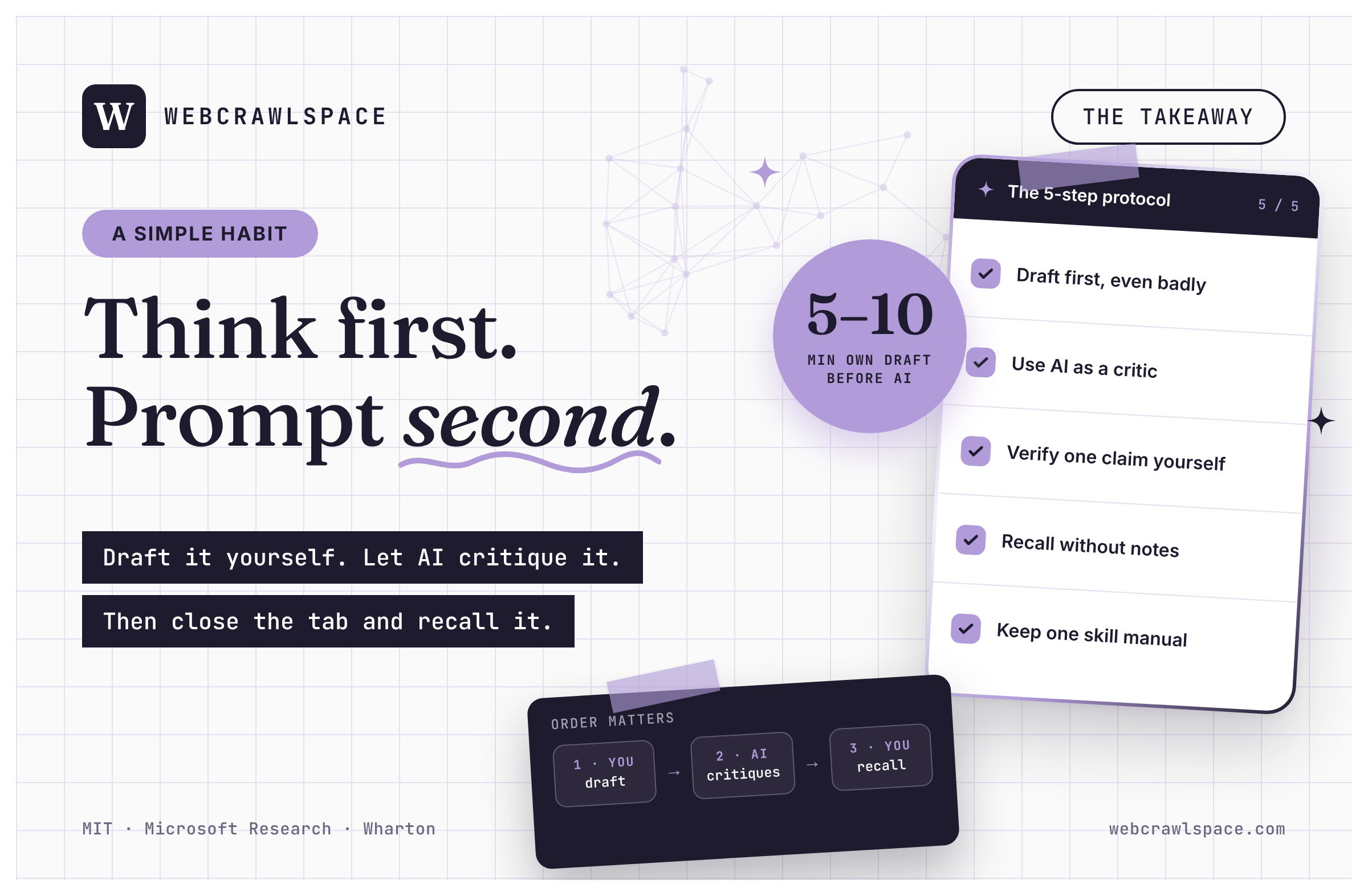
- Think before you promptBefore opening ChatGPT, Claude or another AI tool, spend five to ten minutes thinking about the task yourself. Write down your initial ideas, outline or hypothesis. You do not need to get everything right; the purpose is to establish your own understanding before introducing external suggestions. If you are developing an SEO strategy, identify the website’s main problems and opportunities before asking AI to review your findings.
- Use AI as a critic, not just an answer generatorInstead of asking AI to complete everything for you, ask it to challenge your ideas: What assumptions am I making? What might I have overlooked? What are the weaknesses in this argument? What would someone who disagrees with me say? Which parts need further verification?
- Verify important information independentlyAI-generated information can be inaccurate, incomplete or outdated. Whenever an answer involves important statistics, research findings, technical recommendations or business decisions, check the original source. If AI recommends changing a website’s indexing configuration, understand why the change is necessary before implementing it.
- Practise recalling information without AIAfter completing a task with AI assistance, close the conversation and try explaining the key points without referring to the generated response. What did I learn? Why did I make this decision? Can I explain the reasoning? Would I know how to approach this task without AI? If you cannot explain the outcome, you may have completed the task without fully understanding it.
- Keep practising the skills that matter to your careerNot every task needs to be automated. Writers should keep practising original writing and argument development. Marketers should understand audience behaviour and campaign strategy. SEO specialists should retain their ability to analyse search intent, technical issues and performance data. Analysts should know how to interpret data rather than simply generate reports. Students should attempt problems before requesting AI help. AI accelerates execution, but underlying expertise is what lets people recognise good work.
What this means for businesses and marketing teams
The discussion about AI and cognitive offloading is not limited to students or individual users. Businesses are increasingly integrating AI into everyday workflows, from content production and customer support to data analysis and strategic planning. While automation can improve productivity, organisations should also consider what happens to employees’ underlying skills when more tasks are delegated to AI.
A marketing team, for example, might use AI to generate campaign briefs, research competitors and develop content strategies. If employees simply accept the generated recommendations, the team may become faster at producing deliverables without necessarily becoming better at making strategic decisions. A more effective workflow would involve employees developing their initial ideas, using AI to challenge their assumptions, and independently validating the final recommendations.
Businesses should also establish clear expectations around:
- Which tasks can be fully automated.
- Which decisions require human judgement.
- Who is responsible for verifying AI-generated information.
- Which professional skills employees should continue developing.
- How AI-generated work is reviewed before implementation.
The objective should be to build teams that can work effectively with AI, rather than teams that cannot function without it. For businesses, this also creates a new consideration: as AI becomes more involved in research and decision-making, maintaining human expertise and accountability becomes increasingly important. If you want to understand how AI is changing the way people discover and evaluate brands, see our ZUS Coffee AI visibility audit.
Frequently asked questions
Does AI affect memory?
AI can affect how people remember and process information, particularly when they rely on it to complete tasks without actively engaging with the material. Research, including the 2025 MIT Media Lab experiment, found that participants who relied on ChatGPT for essay writing demonstrated poorer recall of their own work than participants who used a search engine or no external tools. However, current evidence does not establish that AI causes permanent memory loss or brain damage.
Does ChatGPT make you less intelligent?
There is no conclusive evidence that using ChatGPT makes people less intelligent. However, relying on AI to perform tasks without understanding the underlying concepts may reduce opportunities to practise important cognitive skills, including reasoning, problem-solving and independent decision-making. The impact depends on how the tool is used.
Can AI reduce critical thinking skills?
AI may reduce critical thinking effort when people accept generated answers without questioning or verifying them. A 2025 Microsoft and Carnegie Mellon study found that greater confidence in AI was associated with less reported critical thinking effort among knowledge workers. However, AI can also support critical thinking when users actively evaluate its suggestions, compare perspectives and verify information.
What is cognitive offloading?
Cognitive offloading is the process of using external tools or resources to reduce the mental effort required to complete a task. Examples include using a calculator for mathematical calculations, Google Maps for navigation or ChatGPT to summarise information. It is not inherently harmful. The concern arises when people consistently delegate tasks that would otherwise help them develop or maintain important skills.
What is cognitive debt?
Cognitive debt is a term used in the MIT Media Lab’s 2025 research to describe the potential cognitive costs of repeatedly relying on AI to perform thinking tasks. The concept suggests that while AI can make tasks easier in the short term, users may miss opportunities to develop understanding, memory and independent reasoning. It is a research concept rather than a clinical diagnosis.
Should we stop using AI to protect our memory?
No. Avoiding AI altogether is not necessarily the answer. AI can help people access information, understand complicated topics, improve productivity and receive personalised learning support. The important distinction is whether AI supports your thinking or replaces it. Use it to explore ideas, challenge assumptions and improve your work, but continue practising the skills you want to retain.
How can I use AI without becoming dependent on it?
Start by attempting tasks independently before asking AI for help. Use AI to review your work, identify weaknesses and explain unfamiliar concepts. Verify important information using reliable sources and practise recalling what you have learned without referring to AI-generated answers.
Final thoughts: think first, prompt second
AI is changing how people work, learn and process information. It can reduce repetitive tasks, make information more accessible and help people complete work more efficiently.
But productivity and learning are not always the same thing. Completing a task faster does not necessarily mean understanding it better. Producing a presentation does not mean understanding the argument behind it. Getting the correct answer from AI does not necessarily mean knowing how to solve the problem independently.
The research does not suggest that everyone should stop using AI. Instead, it highlights the importance of remaining actively involved in the thinking process. Use AI to improve your ideas, not replace them. Let it challenge your assumptions, but do not let it make every decision for you.
The real advantage will belong to people who know how to use AI while retaining the ability to think independently.
Think first, prompt second.
Sources and further reading
- Kosmyna, N. et al. (2025). Your Brain on ChatGPT: Accumulation of Cognitive Debt when Using an AI Assistant for Essay Writing Task. MIT Media Lab / arXiv. https://arxiv.org/abs/2506.08872
- Lee, H.-P. et al. (2025). The Impact of Generative AI on Critical Thinking. CHI 2025, Microsoft Research and Carnegie Mellon University. https://doi.org/10.1145/3706598.3713778
- Gerlich, M. (2025). AI Tools in Society: Impacts on Cognitive Offloading and the Future of Critical Thinking. Societies, 15(1), 6. https://www.mdpi.com/2075-4698/15/1/6
- Bastani, H. et al. (2025). Generative AI without guardrails can harm learning: Evidence from high school mathematics. PNAS, 122(26). https://doi.org/10.1073/pnas.2422633122
- Kestin, G. et al. (2025). AI tutoring outperforms in-class active learning. Scientific Reports, 15, 17458. https://doi.org/10.1038/s41598-025-97652-6
- Sparrow, B., Liu, J. & Wegner, D. M. (2011). Google Effects on Memory. Science, 333(6043), 776–778. https://doi.org/10.1126/science.1207745
- Henkel, L. A. (2014). Point-and-shoot memories: The influence of taking photos on memory for a museum tour. Psychological Science, 25(2), 396–402. https://doi.org/10.1177/0956797613504438
- Dahmani, L. & Bohbot, V. D. (2020). Habitual use of GPS negatively impacts spatial memory during self-guided navigation. Scientific Reports, 10, 6310. https://doi.org/10.1038/s41598-020-62877-0
- Alubthane, F. O. (2026). Amplifier or substitute? A systematic review of generative AI’s impact on higher-order cognitive skills among university students. Frontiers in Psychology, 17, 1863931. https://doi.org/10.3389/fpsyg.2026.1863931
- Farhat, Z. (2026). When AI Thinks for Us: Unveiling the Cognitive and Social Toll of ChatGPT Over-Reliance. Applied Cognitive Psychology, 40(3), e70205. https://doi.org/10.1002/acp.70205
- Qian, W. et al. (2026). Generative AI and cognitive load in education: A systematic review of WoS/SSCI-indexed studies through the lens of cognitive load theory. Frontiers in Psychology, 17, 1921504. https://doi.org/10.3389/fpsyg.2026.1921504